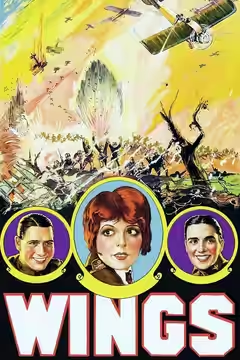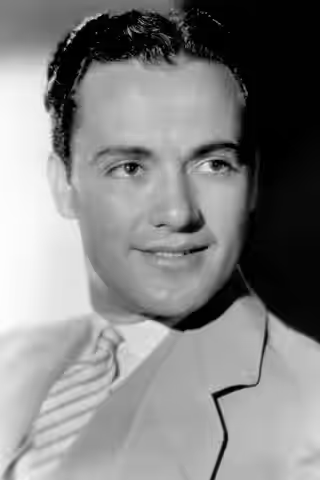
Rogers was the boy next door for as long as Hollywood needed one: eager, clean-cut, pleasant to look at and not much more. Wings (1927) is the one to see, and even there Clara Bow and Richard Arlen are the ones you watch.
Fi1m perspective
In Wings (1927) Jack Powell is building a racing car at home, and the girl next door is in love with him, and he has not noticed. That is Charles Rogers's screen career in one image: a nice boy, busy with something, looked at by someone he is not looking back at. Clara Bow's Mary does everything in that scene. She moves, she sulks, she changes her mind. Rogers grins at the engine.
He had come to Hollywood in 1926 and by his own account was ready to give it up. "I just wanted to say the heck with it and go back to Kansas. Then I had lunch with Billy Wellman and he put me in 'Wings' and there went Kansas." Wellman had flown in the war and wanted his fliers in real aircraft, and Rogers did the work: the aerial scenes are the reason the film still holds, and he is in them. Paramount then sold him as America's Boyfriend and kept him at it through the early 1930s, in My Best Girl (1927) opposite Mary Pickford and Abie's Irish Rose (1929) opposite Nancy Carroll, with whom he was paired five times. The pictures were about a pleasant young man getting the girl, and he was a pleasant young man, and he got her.
The honest thing to say is that he never did much else. He was open-faced and willing and he could carry a scene without spoiling it, which is a skill, and it is not acting. In Wings we kept waiting for him to do something Bow had not already done first, and he never did. Richard Arlen, as the rich boy in the next bunk, gets the same thin material and is quieter and better with it, and Henry B. Walthall and Julia Swayne Gordon, as Arlen's parents seeing their son off, moved us more in a minute than Rogers manages across the whole triangle. Critics at the time said he was agreeable and no more. His answer was to go and lead a band.
The band is the second act. He ran his own dance orchestra and played several instruments on screen, and the studios built pictures around it: Old Man Rhythm (1935) and Dance Band (1935), the kind of musical comedy in which the plot exists to get the band on stage. Some of these were bad, and nobody has argued otherwise. He kept working in films until 1957 and turned up as a guest on television afterwards.
If you want to see him, see Wings, and see it for the air, where Wellman's cameras are inside the aircraft and Rogers is up there in a real cockpit in a real sky. On the ground, look at Bow. The film does.
Biography
Charles Edward 'Buddy' Rogers (1904–1999) was an American actor and musician. Born in Olathe, Kansas, he studied at the University of Kansas before beginning his professional acting career in Hollywood in the mid-1920s.
Rogers is best known for his leading role as Jack Powell in the 1927 silent film Wings, the first film to win the Academy Award for Best Picture. During the late 1920s and early 1930s he appeared in numerous films and was publicised as 'America's Boyfriend'. He also worked as a bandleader and made later television appearances.
In 1937 he married silent-film star Mary Pickford; the couple remained together until her death in 1979 and adopted two children.