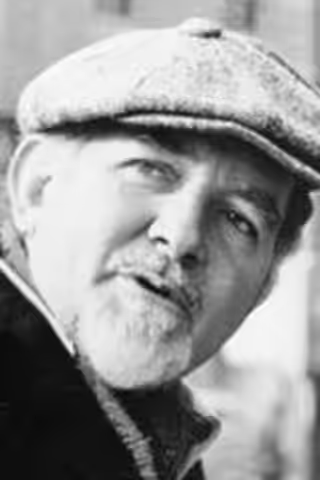
Charles Jarrott came to the cinema from live television and never quite left it: two people in a well-dressed room, speaking good lines well, until the scene ends. Handsome, well-spoken, slow, and worth an evening only when the actor is worth it.
Fi1m perspective
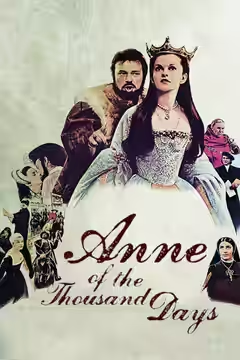
A king wants a woman. He tells her so in a room. She tells him what she thinks of that, in the same room, and then Richard Marden cuts to the next room, where somebody else explains what has happened at court. That is Anne of the Thousand Days (1969), Charles Jarrott's first feature, for 145 minutes. The break with Rome, the fall of a chancellor, the oath put to More and Fisher: none of it is shown, all of it is reported. Richard Burton is Henry, Geneviève Bujold is Anne, and whenever she is on screen the film has a pulse. Whenever she is not, it has a script.
The habit was learned honestly. Jarrott acted in repertory at Nottingham, went to Canada in 1953 to direct television plays for the CBC under Sydney Newman, and came home to the BBC for Armchair Theatre and The Wednesday Play, where he handled Pinter and Wesker. In 1969 Hal B. Wallis brought him to Hollywood and gave him the Tudors. He said of the move that "if you've done live TV, you can do anything. It teaches you the most enormous discipline." He is right about the discipline. Everyone in Anne is in the right place, saying the right line, at the right moment.
Wallis kept him for Mary, Queen of Scots (1971), with Vanessa Redgrave and Glenda Jackson, and then Jarrott took on a musical, Lost Horizon (1973), which failed badly enough to bend the rest of his career. The Other Side of Midnight (1977) followed, and after that he worked mostly in television films until his last credit in 2002. It is hard not to feel he had gone back to where he was most at ease.
What he could do was get a performance. Bujold's Anne has a temper and a brain, and a director who could not see actors would not have let her keep either. What he could not do, or did not want to, was stage an event as anything but a conversation about it. Critics at the time found no style in him at all. We would put it less unkindly: he had a style, and it was television's, and a cinema screen exposes it. By the middle hour of Anne we were checking how long was left, and we felt mean about it, because everyone on screen was plainly trying and the words were good. It is a peculiar kind of boredom, the sort you feel in a well-run meeting.
Watch Anne of the Thousand Days at home, where it looks like what it is: a very good television play with better frocks. Stay for Bujold. If you find yourself admiring the tapestries on the wall behind her, that is not entirely your fault.
Biography
Charles Jarrott (16 June 1927 – 4 March 2011) was a British film and television director. Born in London, he served in the Royal Navy during the Second World War. After the war he joined the Nottingham Repertory Theatre as an actor and later worked as a stage manager and director. In 1953 he moved to Canada, where he began directing television plays.
Jarrott's feature film debut was Anne of the Thousand Days (1969), produced by Hal B. Wallis. He followed this with Mary, Queen of Scots (1971). He won the Golden Globe Award for Best Director for Anne of the Thousand Days. His other feature films include Lost Horizon (1973), The Last Flight of Noah's Ark (1980) and Condorman (1981). He also directed numerous television films and series from the 1950s to the early 2000s.