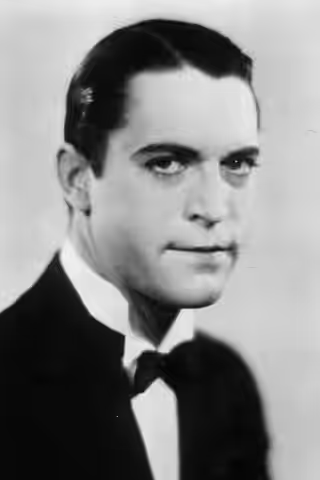
Chester Morris's gift was doing less than everyone around him. In The Big House his stillness is what makes Wallace Beery look enormous. Hollywood spent the next two decades finding smaller and smaller uses for it.
Fi1m perspective
In The Big House (1930), three men share a cell: a murderer, a frightened rich boy and a forger, and the forger is the one you stop watching. That is the performance. Wallace Beery's Butch fills every doorway George W. Hill puts him in. Robert Montgomery's Kent is the weak one and does not hide it. Chester Morris's Morgan keeps his head down and his voice level, and the film uses him as the fixed point the other two are measured against. Take him out and Beery is just loud.
Morris came to sound pictures from the stage, where he had been working since he was fifteen, and Alibi (1929), his first talkie, put him where the studios would keep him: a gangster, square-jawed and slicked back. The Big House made him a leading man. For a few years he was the hard man in pre-Code pictures opposite the big female stars, Jean Harlow among them in Red-Headed Woman (1932). Then, by the mid-1930s, the parts got smaller and the pictures cheaper; Five Came Back (1939) came out of that stretch. After it came Boston Blackie, fourteen films between 1941 and 1949, which paid the bills and fixed the label. He spent the rest of his working life mostly on stage and in television.
The standard complaint is that he had none of the wit of Cagney or Powell in the same sort of role. This is true and it is not quite the point. Morris did not do sparkle; he did the man who has already worked out the odds and is waiting to see whether anyone else has. He knew it about himself. "Anybody can play nice boys," he said of a stage part, and his screen career is largely a record of him declining to. The trouble is that Hollywood had one use for a quiet hard man in 1930 and a cheaper one by 1940.
We felt his limits most sharply in The Big House itself, in the scenes outside the walls with Leila Hyams, where the script orders a romance and the two of them obey it. Morris is patient and courteous and there is nothing between him and Hyams that the script did not put there, and for a quarter of an hour we were faintly embarrassed on his behalf, a good actor being polite to a story he had no part in. Put him back in the mess hall and he is fine again. He needed a room with pressure in it.
If you know the name at all it is probably from the Blackie films, and that is the wrong door. Start in the cell block, with the man who is not talking, and notice how much of the film is arranged around his silence. Then decide whether fourteen detective pictures were the right thing to do with it.
Biography
Chester Morris (born John Chester Brooks Morris) was an American stage, film, television and radio actor. He made his Broadway debut in 1918 and transitioned to sound films with the 1929 crime drama Alibi, for which he received an Academy Award nomination for Best Actor.
Morris appeared in several notable early sound films, including The Divorcee (1930) and The Big House (1930), in which he played John Morgan. He is best remembered for portraying the criminal-turned-detective Boston Blackie in a series of fourteen films released by Columbia Pictures between 1941 and 1949. He continued working in television and occasional films until his death in 1970.