A British director of drawing-room repression whom Hollywood handed a safari and then took it back. His reputation rests on one film, The Seventh Veil (1945), and on the rare honesty with which he later said so himself.
Fi1m perspective
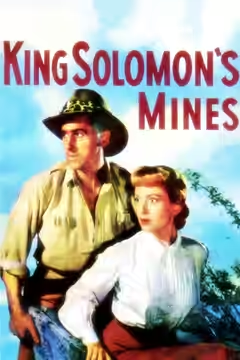
King Solomon's Mines (1950) feels like two films, and it is. One is brisk and plain, a journey across real Africa with nothing on the soundtrack for long stretches but drums, birds and hooves. The other is stiffer, a woman and a hunter learning to be civil to one another in Technicolor. Compton Bennett was hired to direct the whole thing and was replaced on location by Andrew Marton, who took the action. It is not hard to guess which of the two films is his.
Bennett came to directing late and sideways. He had been a bandleader and a commercial artist, made amateur films, and on the strength of them got an editing job at Alexander Korda's London Films in 1932. The war put him on instructional and propaganda films. His first feature, The Seventh Veil (1945), was a psychological melodrama built on hypnosis and flashback, with James Mason and Ann Todd in a story of obsession, and it made his name. It also set the pattern for what he did well: repression, obsession, two people in a room, actors working at full intensity. The Years Between (1946) followed in the same key, and MGM brought him to Hollywood, where he made That Forsyte Woman (1949) from Galsworthy before the safari.
Then the safari went wrong. Bennett was not an action director and nobody had asked him to be one until this. What we can say from the finished film is that the human scenes he was there for are the ones that sag, and the animals that Marton was brought in for are the reason to watch. We grew restless during the romance and wanted the drums back, and we do not think that was the effect anyone intended. At 103 minutes it is still worth an evening; it is simply not an evening that argues for Bennett.
He went home. From 1954 he worked in theatre and television, directed several films in 1957, After the Ball among them, and gave up features after 1960. None of it was received as The Seventh Veil had been, and Bennett knew it. His own summary was that he had "spent the rest of his career being found out", and he named It Started in Paradise (1952) as the evidence. Directors do not usually say that about themselves. Most spend their decline insisting the material let them down. Bennett's honesty is the second most interesting thing about him, and it says something that the first is a film he made when he was forty-five.
Biography
Compton Bennett (also credited as Bob Compton-Bennett) was an English film director, writer and producer. He began his career as a band leader and commercial artist before making amateur films that led to a position as a film editor at Alexander Korda's London Films in 1932. During the Second World War he worked on instructional and propaganda films for the British armed forces.
Bennett's feature directorial debut was The Seventh Veil (1945). He later moved to Hollywood, where he directed King Solomon's Mines (1950) for MGM, though he was replaced during production by Andrew Marton. He returned to the United Kingdom and continued directing for film and television, with later credits including After the Ball (1957) and The Flying Scot (1957).
Bennett was born in Tunbridge Wells, Kent. He died in 1974.