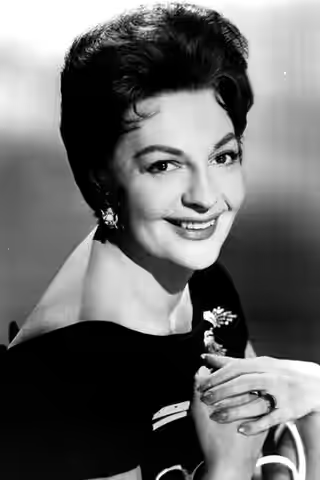
Coral Browne played the woman at the top of the table: tall, exactly spoken, and quicker than everyone round her. Film gave her supporting parts for forty years and then, late, two roles that showed what it had been missing.
Fi1m perspective
Coral Browne arrives in a scene already certain she is the cleverest person in it, and she is usually right. Tall, straight-backed, every consonant in place, she specialised in the sophisticated and the acid: the rich aunt, the actress friend, the producer who gets her way. The timing is a comedian's, and the voice was trained on stage, where a line has to reach the back row and still sound like conversation. On screen she did not lower it.
She started on stage in Australia in 1931 and came to England three years later, and the West End took her up fast: comedies first, then the classics, and by the late 1940s she was among the best-paid actresses in London. Lady Macbeth at the Old Vic followed in 1956. Films came from the mid-1930s, but mostly as supporting parts, and in the early ones, Black Limelight (1938) and Let George Do It (1940), she can look too large for the frame, flattening the leading men she is meant to be decorating.
Auntie Mame (1958), with Browne as Vera Charles, the gin-soaked actress friend, is the one most people have seen, and it got her noticed in America. The sixties and seventies brought the parts she is remembered for: Mercy Croft, the television producer who takes what she wants in The Killing of Sister George (1968), and Lady Claire Gurney, the aunt with appetites in Peter Medak's The Ruling Class (1972). The predatory older woman could in other hands be a cartoon; Browne plays her as someone who has thought it through and decided to go ahead. What does not work is harder to blame on her. A career this good on stage never became a leading one in film, and the filmography is thin and scattered: character turns that stand out from their ensembles, Theatre of Blood (1973) opposite Vincent Price among them, and not much else.
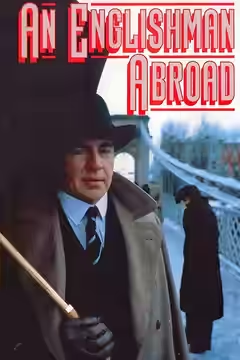
Then, late, two films asked her to play old. John Schlesinger's An Englishman Abroad (1983), written by Alan Bennett, has her as herself, meeting Guy Burgess in Moscow in 1958. She said afterwards, "That wasn't a performance, really. I was simply playing myself." We think that is modesty: the wit and the wariness are both hers, and both are placed exactly where the scene needs them. Dreamchild (1985) gives her Alice Hargreaves, the woman Lewis Carroll's Alice was written for, now elderly and unsure what to make of the child she was. We expected the grande dame and got an old woman trying to decide what her childhood had meant, and it moved us more than forty years of acid had prepared us for, because for once the authority is gone and she lets us watch her look for it.
She counted Dreamchild among the three best things she ever did. Start there, go back to Moscow, and keep the parties for a night when you want someone to be unkind on your behalf.
Biography
Coral Edith Browne (23 July 1913 – 29 May 1991) was an Australian actress who worked primarily in Britain and the United States. She began her stage career in Melbourne before moving to England in 1934, where she became established in West End comedies and later appeared in Broadway productions including Macbeth (1956).
Her film roles included Vera Charles in Auntie Mame (1958), Mercy Croft in The Killing of Sister George (1968), Lady Claire Gurney in The Ruling Class (1972) and Alice Hargreaves in Dreamchild (1985). She played herself in the BBC television film An Englishman Abroad (1983), for which she received the BAFTA Television Award for Best Actress.
Browne met actor Vincent Price while filming Theatre of Blood (1973); they married in 1974. She became a naturalised United States citizen in 1987.