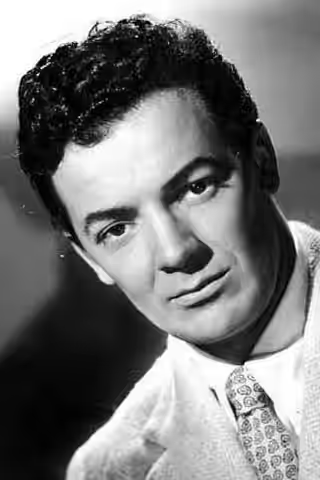
Cornel Wilde was an athlete first and an actor second, and the films that knew it are the ones worth watching. Hollywood cast him as a costumed romantic lead; the films people still talk about are the ones he wrote and directed himself.
Fi1m perspective
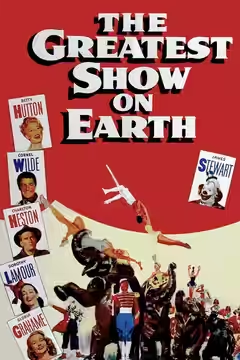
Watch Cornel Wilde climb. In The Greatest Show on Earth (1952) he goes up to the trapeze as The Great Sebastian grinning, and he is still grinning when Betty Hutton starts shouting at him from the other platform. The two of them try to outdo each other, the camera goes up into the rigging after them, and we gripped the arm of the sofa. We did not believe the rivalry for a second; we believed the bodies in the air and the sawdust a long way below. At ground level the film is stiff and the talk is pompous, and Wilde has the easiest time of anyone in it, all teeth and shrugs. That is the Wilde we know: better in motion than in conversation, and happiest when the part gives him something to hang from.
He came to films from the stage and from the sword. He was fencing choreographer and Tybalt in Laurence Olivier's 1940 Romeo and Juliet, and had made his film debut in 1937. The break was Frédéric Chopin in A Song to Remember (1945), a consumptive composer at a piano, about as far from a rapier as a part can get. Then 20th Century Fox took him on and spent the rest of the decade putting him into melodramas and swashbucklers, Leave Her to Heaven (1945) among them, and the typecasting set in.
The turn came in the 1950s. He went freelance, formed Theodora Productions with his second wife Jean Wallace, and from the middle of the decade began writing, producing and directing the films he starred in; he and Wallace made eight together. The Big Combo (1955) is a noir on which he was also associate producer. The Naked Prey (1965), which he produced, directed and played the lead in, is the one that still gets talked about, for how plainly it shows a man being hunted and how little it dresses up the violence. We have not reviewed it and will not judge it here. What we can say is that the man who stopped waiting for a studio to send him a script is a good deal more interesting than the one on the trapeze.
The complaint about his directing was that it was crude by the standards of the studios he had left, and it may well have been. He was making films about people trying to kill one another and what that does to them, and he did not stop to make them pretty. "Acting is not just 'another day, another dollar'. If I hate a script or think it's foolish or in bad taste, I'm miserable," he said in 1954, and it goes some way to explaining why he ended up behind the camera. Start with the trapeze, which is worth the climb on its own, then go and find what he made once nobody was telling him to grin.
Biography
Cornel Wilde was a Hungarian-American actor and filmmaker. Born Kornél Lajos Weisz on 13 October 1912 in Prievidza, Hungary (now Slovakia), he emigrated to the United States as a child. He began his career on Broadway in the mid-1930s before making uncredited film appearances from 1937.
He became a leading man in the 1940s under contract with 20th Century Fox. Wilde received an Academy Award nomination for Best Actor for his role as Frédéric Chopin in A Song to Remember (1945). Other notable performances include Leave Her to Heaven (1945), The Greatest Show on Earth (1952) as The Great Sebastian, and The Big Combo (1955). From the 1950s he also wrote, produced and directed films, including The Naked Prey (1965). He died in Los Angeles on 16 October 1989.