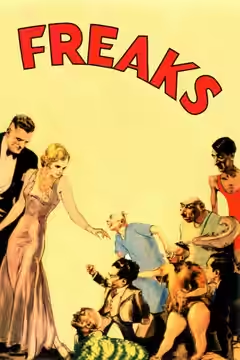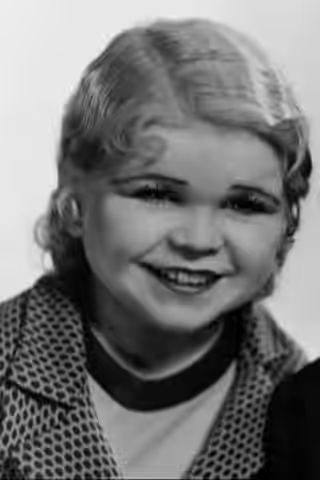
Daisy Earles makes Frieda’s ordinary romantic worries matter in Freaks, despite dialogue that often works against her. Her screen career was intermittent, but this substantial role is worth seeking out.
Fi1m perspective
In Freaks (1932), Daisy Earles’s Frieda is concerned for Hans, the man she is engaged to. That gives her a place in the film beyond the display of its sideshow performers. Her jealousy and affection are recognisable, even when the dialogue is stiff. We were moved by her worry for him, despite exchanges that made intimacy sound rehearsed. It is a performance worth seeking out, with reservations about how readily the romantic scenes convince.
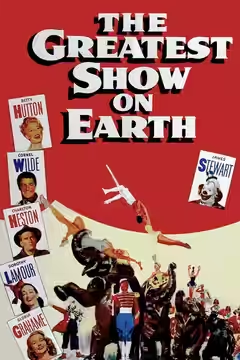
Her screen career was intermittent, with Freaks providing her most prominent role. Three-Ring Marriage (1928) preceded it; an uncredited Munchkin appearance in The Wizard of Oz (1939) and a brief uncredited part in The Greatest Show on Earth (1952) followed. Film work was largely fitted into the off-season of a circus career that included roughly thirty seasons with Ringling Bros. and Barnum & Bailey Circus. Frieda consequently carries much of the weight when we judge what she could do on screen.
Tod Browning’s affection for the performers is one reason Freaks works, and Earles benefits from being given a place in its central melodrama. Alongside Harry Earles as Hans and Olga Baclanova as Cleopatra, she is asked to sustain romantic feeling through Leon Gordon and Willis Goldbeck’s awkward dialogue. Harry’s directness is affecting, but the writing can make even his sincerity sound prepared. Daisy’s scenes in German and English give her concern and jealousy to express, feelings that need little explanation. The difficulty is making the spoken exchanges sound like something these people would say to one another.
The film’s treatment of bodily difference complicates our response to Earles. Browning’s affection for the circus performers never settles the troubling business of making them an attraction. Giving Frieda an emotional life matters, but it does not exempt the film from that difficulty, or make the acting consistently persuasive. Start with Freaks for Earles; the brief appearances elsewhere cannot tell us nearly as much about how she handles a substantial part.
Biography
Daisy Earles, born Hilda Emma Schneider on 29 April 1907 in Stolpen, Germany, was an actress and circus performer with dwarfism. She migrated to the United States in the early 1920s and performed with her siblings Harry Earles, Gracie Earles and Tiny Earles, initially under the name The Earles and later as The Doll Family.
Earles appeared in the 1928 film Three-Ring Marriage. She is best known for playing Frieda in the 1932 film Freaks, opposite her brother Harry Earles. She also appeared uncredited as a Munchkin in The Wizard of Oz (1939) and as a midget in The Greatest Show on Earth (1952).
The siblings toured with circuses including Ringling Bros. and Barnum & Bailey for around thirty seasons. Earles retired from performing in 1958 and lived in Sarasota, Florida, where she died on 15 March 1980.