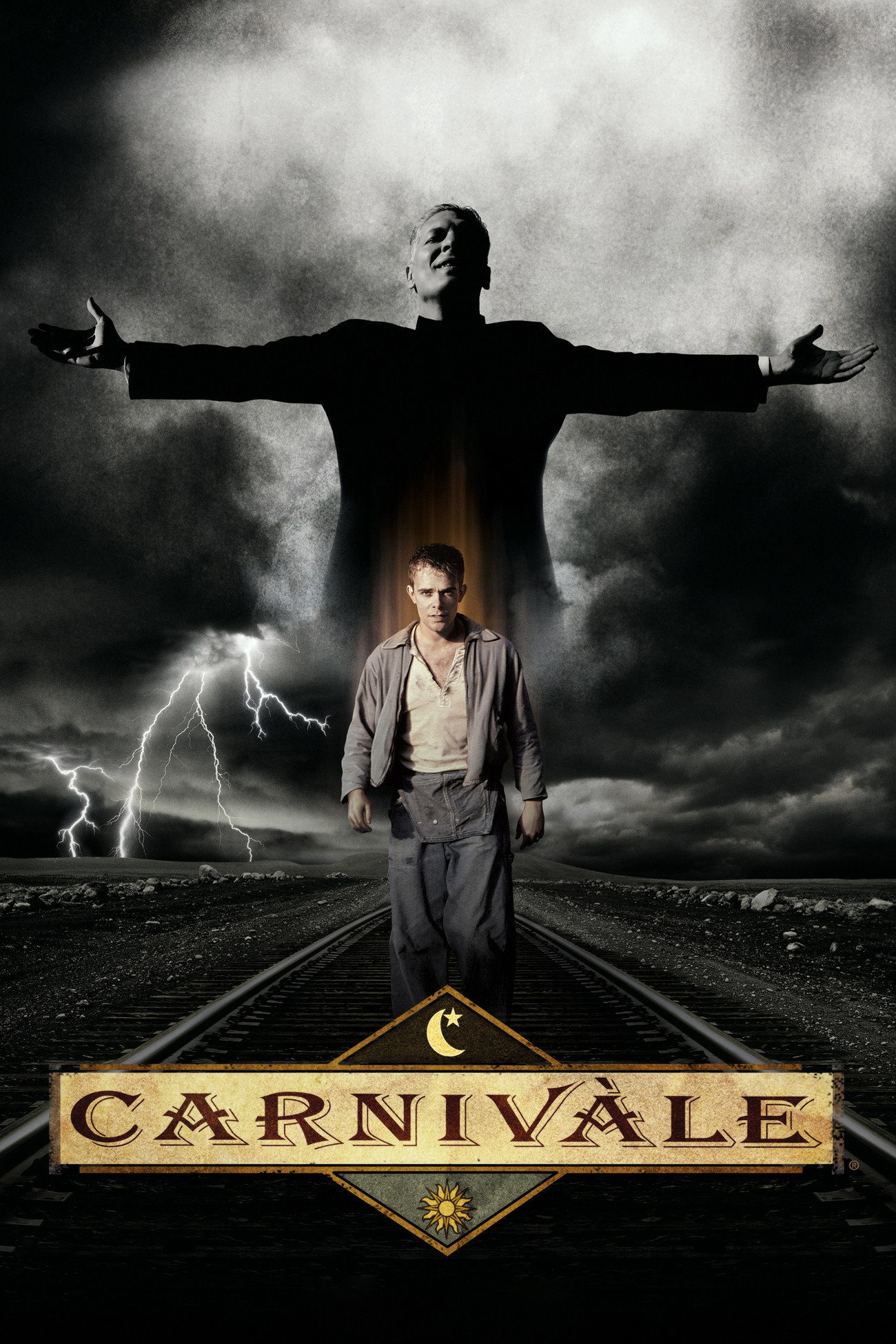
Daniel Knauf made one series that looked like nothing else on television and it was stopped before he could finish it. He has spent most of the years since writing on other people's shows, and Carnivàle remains the reason to know his name.
Fi1m perspective
A carnival crosses the Dust Bowl in 1934. Somewhere in California a preacher has started to hear God. Knauf's idea in Carnivàle (2003) was to put those two stories on the same screen and make us wait, for a long time, before they came anywhere near each other. The tagline he gave it, into each generation is born a creature of light and a creature of darkness, is his whole subject, and he has kept coming back to it: light against dark, in settings that are mythic or supernatural or both. He did not hurry. Twenty-four episodes, each a little under an hour, and none of them rushed.
He came to it late, from a career in health insurance, with one credit behind him, the 1994 HBO film Blind Justice, and pages he had put online. What he built from there was a world complete enough that everyone who arrived had to work inside it. The directors who passed through, Jeremy Podeswa, Todd Field, Peter Medak and Alan Taylor among them, all kept to the same low light and the same slow rhythm; with Ronald D. Moore producing, Knauf set the tone and nobody was allowed to be flashy. That is his strength as a creator, and it is rarer than it sounds. We thought the result good: beautifully built, patiently acted and unfinished.
It was cancelled after two seasons, short of what he had planned, and the last episode stops rather than ends. We were angry when it did, not at the series but on its behalf, because the faces, the dust and Jeff Beal's score had earned a finish and the two stories had taken most of the run to come within shouting distance of each other. That anger is the cost of the pace. A show that asks for that much patience owes its audience an ending, and this one was not given the chance to pay.
Since then he has mostly worked on other people's shows: Supernatural, Standoff, the first season of Spartacus: Blood and Sand (2010), Dracula (2013), which he ran, and 59 episodes of The Blacklist between 2014 and 2017. We have not reviewed them and will not judge them here. It is enough to say that none of them is a series a viewer would name as Knauf's. The Astronauts (2020), a children's science fiction show for Nickelodeon, is the first series he has created since Carnivàle, and it is a smaller thing by design.
He has said that he writes "like a guy who is being chased by a bunch of guys with machetes." Nothing in Carnivàle moves like that. It is the slowest, most patient thing he has written, and it is the one that lasted. Start there, and go in knowing it will not finish.
Biography
Daniel Knauf is an American television screenwriter, producer and showrunner, also credited as Dan Knauf. Born and raised in Los Angeles, he studied fine art and English, graduating from California State University, Los Angeles in 1982. He worked for nearly two decades as an employee benefits consultant and health insurance broker before writing full time.
Knauf wrote the 1994 HBO television film Blind Justice and created the 2001 pilot Honey Vicarro. He wrote for Wolf Lake (2001–2002) and directed the 2002 film Dark Descent. He is best known as creator, writer and executive producer of the HBO series Carnivàle (2003–2005). Subsequent credits include writing for Supernatural (2006), Spartacus: Blood and Sand (2010), Dracula (2013) and The Blacklist (2014–2017), as well as comic book work with his son Charles Knauf.