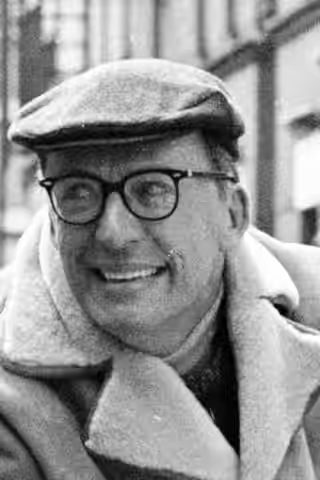
Daniel Mann was a theatre man who filmed plays by putting a good actor in a room and staying out of the way. When the actor was Anna Magnani that was enough; when it was not, the room was all you noticed.
Fi1m perspective
Watch The Rose Tattoo (1955) and notice where the camera is. It sits in the corner of Serafina's small house and stays there while Anna Magnani, three years a widow and still in her slip, shouts at a priest. Scenes begin when somebody comes through the door and end when somebody leaves. That is Daniel Mann's method in one film: find the performance, point the camera at it, and do nothing that might get in its way. We laughed out loud at Magnani, and not at her expense; she is so certain of her grievance that the priest's discomfort became ours, and we would have sat through another hour of it.
Mann came to films from the stage. He trained as an actor at the Neighborhood Playhouse under Sanford Meisner, directed on Broadway from the late 1940s, and made his first film, Come Back, Little Sheba (1952), from a play he had already directed in the theatre. That became the pattern. Through the 1950s, his busiest decade, he specialised in plays and books brought to the screen, often staging the play first, and he worked twice each with Shirley Booth and Burt Lancaster. The reputation he acquired is the one such directors usually acquire: an actor's director, with a good ear for how stage dialogue should sound once a microphone is close enough to hear it.
The consensus is that the good years ended around the middle of that decade, and we see no reason to argue. BUtterfield 8 (1960) is generally filed under melodrama and left there. Our Man Flint (1966) is a spy comedy, a long way from Tennessee Williams. Willard (1971) is a horror film, which nobody watching the Magnani picture would have predicted. He kept working into the 1980s, in television as much as cinema, and Playing for Time (1980), made for television, is the late work people still speak well of. We have not reviewed these and will not pretend to a view on them, beyond noting the shape: one decade of filming plays, then three of filming what came.
What works is the acting, and that is not nothing. Getting Magnani onto film as she was, loud and unpolished and impossible to look away from, is a real achievement, and Mann deserves credit for knowing what he had and not fussing it. What does not work is everything the camera might have added and did not. The house in The Rose Tattoo never stops looking like a set. The strand with Rosa's sailor is stiff because Ben Cooper is stiff and Mann had no way to shoot round him, only to record him. Staying out of the way only works when the person in front of the camera can carry the film alone.
Start with The Rose Tattoo, for Magnani. Then, if you want to see what he did with a play he had already directed on stage, Come Back, Little Sheba. After that, lower your expectations and you may be pleasantly surprised; we would not bank on it.
Biography
Daniel Mann, born Daniel Chugerman, was an American stage, film and television director. He was born on 8 August 1912 in Brooklyn, New York, and died on 21 November 1991 in Los Angeles, California.
Trained as an actor at the Neighborhood Playhouse, he directed numerous Broadway productions before moving into films in 1952. Most of his work consisted of adaptations from the stage and literature, including Come Back, Little Sheba (1953), The Rose Tattoo (1955), The Teahouse of the August Moon (1957) and BUtterfield 8 (1960). He directed more than thirty feature films and television productions between 1952 and 1987.