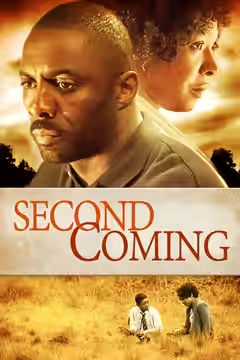
Debbie Tucker Green writes talk the way other directors write music, and then trusts silence to do the rest. Her films are patient, ambiguous and unlike anyone else's in British cinema, and they ask for more patience than most viewers will give.
Fi1m perspective
A family dinner in Second Coming (2014). Jax's relatives talk over one another, her husband Mark chooses this table to say the thing he has been holding in, and Jax, who is pregnant and has not slept with him in months, says almost nothing. Nobody at the table is wrong, exactly. Debbie Tucker Green writes a family as one body and makes Jax the part that has stopped responding. We sat rigid through it, because the scene gives us no one to side with and no way out, and Nadine Marshall's face gives away nothing while telling us everything.
That is her method, and it was a stage method first. Tucker Green spent a decade as a stage manager before she wrote a play, and the plays she began producing in the early 2000s, at Soho Theatre and Hampstead Theatre, were built on talk: London speech with a Caribbean cadence, repeated, interrupted, punctuated to the syllable. Screen came later and on her terms. She adapted random for television in 2011 and directed it herself, with Marshall in the lead; she made Second Coming as her first feature three years on; and she went back to her own 2018 Royal Court play for ear for eye (2021). Every time she has directed her own words. Every time Marshall has been in front of the camera.
What the method buys is performance. Marshall carries 105 minutes of Second Coming on a premise the film declines to explain, and Idris Elba is quietly good beside her. Tucker Green puts a family in a kitchen and lets what they say, and when they stop saying it, do the work that exposition does in other films. Luke Sutherland has scored two of her films, and the music in them is part of the structure rather than laid on top; silence is treated the same way. "I think in pictures, so I saw lots of air around this story," she said of Second Coming, and the air is there in the frame, around people who do not fill it.
What the method costs is patience, and not everyone will pay. The ambiguity that makes Second Coming look and sound like nobody else's film also left some viewers unsure what they had watched, and we had our own stretches of admiring the nerve while wishing for a little less of it. ear for eye, a triptych about racial injustice in Britain and America, keeps the stylised, dialogue-heavy delivery of the play it came from, and some critics found that kept them at a distance. Her two features arrived seven years apart. A filmmaker who waits for quiet before she speaks is not going to be hurried.
Start with Second Coming, at home, in the evening, with the phone in another room. It notices when you stop paying attention. So does she, which is why there is so little of her work and why what there is holds.
Biography
debbie tucker green is a British playwright, screenwriter and director. Born in London, she worked for a decade as a stage manager before turning to writing. Her stage plays, many produced at the Royal Court Theatre and the Young Vic, include dirty butterfly (2003) and born bad (2003), the latter winning the Olivier Award for Most Promising Newcomer in 2004.
She adapted her play random for Channel 4 in 2011, winning a BAFTA for Best Single Drama. Tucker green made her feature debut with Second Coming (2014), which she wrote and directed; the film premiered at the Toronto International Film Festival and received a BAFTA nomination for Outstanding Debut by a British Writer, Director or Producer. She later wrote and directed the film ear for eye (2021), adapted from her stage play.