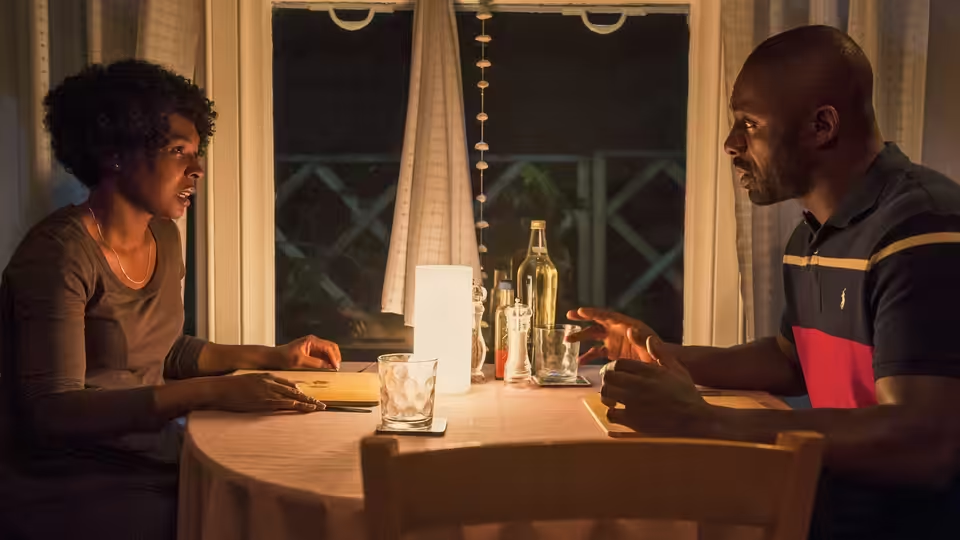
Debbie Tucker Green’s first film takes a woman who is pregnant without explanation and refuses to explain her. Nadine Marshall is remarkable, Idris Elba is quietly good, and the film around them is patient to a fault. Worth the evening, if you have the patience too.
Debbie Tucker Green comes to cinema from the theatre, and her first film has a stage writer’s nerve. It takes a premise most films would spend their length explaining and declines to explain it at all. Jax (Nadine Marshall) is pregnant. She and her husband Mark (Idris Elba) have not slept together in months. She says nothing, to him or to anyone, and Second Coming sits with her in that silence for 105 minutes. Whether this is a miracle, an affair or something she cannot yet put words to is a question raised in the first ten minutes and then left on the table. We admired the nerve. We did not always enjoy the wait.
Marshall is the reason to see it. Jax barely speaks, and when she does it is in half-sentences that stop before the hard word. Marshall plays her as a woman who has gone somewhere behind her own face, and she lets us see how much it costs to stay there: the set of the shoulders at the sink, a direct question answered with a slow blink. At work she lets her friend Bernie (Sharlene Whyte) talk at her and gives nothing back. It is a performance made almost entirely of refusals, and it holds the screen for the whole running time.
Elba is cast against what he usually does, and it suits him. Mark is a talker, an easy, physical father who wrestles JJ (Kai Francis Lewis) on the stairs and fills every room he walks into, and for the first half hour his warmth is the film’s warmth. Then he starts asking questions, and the asking turns into something harder, and Elba lets the charm sour a degree at a time without ever playing a villain. Lewis, as the boy between them, does almost nothing and does it well. He watches his parents the way children do, knowing something is wrong before he knows what.
Urszula Pontikos shoots the house in whatever light the house has, which is not much: lamplight, the television, grey from the window. Lisa Marie Hall’s rooms are cluttered and particular, coats on the banister, a kitchen that has been cooked in for years. The one place lit differently is the bathroom, and we will say only that water falls where water should not, and that the first time it happened we were unsettled and were not sure the film wanted us to be. Mark Eckersley cuts conversations off before they finish and holds on faces after they do, so the rhythm is a stage rhythm, overlapping and interrupted. There is almost no music. The soundtrack is the radio, the kettle and the stairs.
The dinner at her parents’ house is the sequence we will remember. Jax’s mother (Llewella Gideon) and her father Vincent (Larrington Walker) preside, the relatives talk over one another, and Mark chooses this table to say the thing he has been holding in. We sat rigid through it. Tucker Green writes the family as one organism with Jax as the part that has stopped responding, and nobody at the table is wrong, exactly, which is what makes it so hard to watch.
What does not work is the middle. Once the film has set its terms it repeats them: Jax silent, Mark pushing, JJ watching, the bathroom again. Around the hour mark we noticed the same scene coming round for the third time and felt the running time, which at 105 minutes should not happen. The sessions with a counsellor (Nicola Walker) are sharp and far too brief; Walker gets one good scene of professional patience and the film moves on. And the refusal to explain, which is brave, is also a way of not deciding what the pregnancy means to Jax, and by the end we wanted the film to have decided.
Most critics have been warm about it, and so are we, with reservations. Tucker Green has made a first film that looks and sounds like nobody else’s, built around a lead performance that gives away nothing and tells us everything. See it at home, in the evening, with the lights down and the phone in another room. It is a film that notices when you stop paying attention, and so, to its credit, will you.