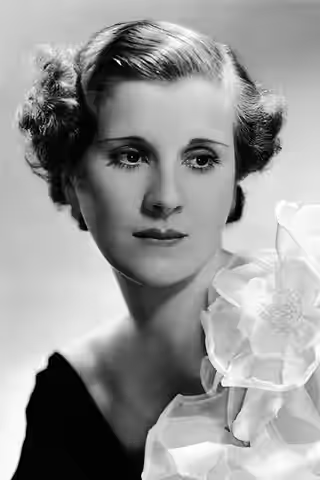
Diana Wynyard took bad news standing up. In her handful of films she played the well-bred Englishwoman who does not crumple, and did it with her face rather than her lines. Hollywood gave her too little to do before she went home to the stage.
Fi1m perspective
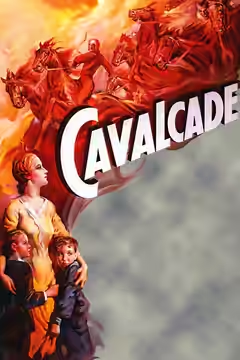
Watch what Diana Wynyard does in Cavalcade (1933) when the news is bad. Her face goes still. It does not crumple, it does not reach for a handkerchief, and Frank Lloyd, to his credit, holds on it and lets the stillness do the work. The script hands Jane Marryot the same speech about waiting three or four times over, and each time Wynyard plays it as if the thought had only just occurred to her. We were moved by her in a film that otherwise left us cold, and it was that refusal to perform grief that did it, in a picture where everything else salutes, weeps and stands for the anthem on cue.
She came to the screen late and left it early. The stage had her from the mid-1920s, first with the Liverpool Repertory Company and then in London, and it was a Broadway debut in 1932 that took her to Hollywood. Her first film there was Rasputin and the Empress (1932), as Princess Natasha opposite the three Barrymores; Cavalcade followed, and she carried Noël Coward's pageant from young wife to grandmother's age with little help from the make-up department. Then, after a few more American parts, she went back to Britain and gave most of the rest of her working life to the theatre: Portia, Gertrude, Lady Macbeth, Beatrice, at Stratford and in the West End. The films after that are few. The one people remember is the British Gaslight (1940), the first screen version of the play, in which she is Bella Mallen, a wife being talked out of her own mind. We have not reviewed it, and will not judge it at length, but the qualities others report in it, a haunted, sympathetic quiet, are the same ones we saw in Jane Marryot.
The method has a cost. Stillness needs something to be still against, and when a script gives her nothing, as Cavalcade's does, she can read as merely composed. The casting did not help. She was put in the well-bred Englishwoman's frock again and again, the woman who waits and endures, and around her the livelier parts went elsewhere: to Clive Brook's moustache and flag, to Una O'Connor's sniff. That she survived Coward's speeches and Lloyd's politeness with her dignity intact is the measure of her; that she had to is the measure of what the studio thought she was for.
It is a small filmography for an actor of her standing, and most of what made that standing was said in rooms we cannot now enter. Start with Cavalcade, and watch her rather than the film, because she is doing something the film is not. Then Gaslight. There is not a great deal more, and there ought to have been.
Biography
Diana Wynyard (born Dorothy Isobel Cox) was an English stage and film actress. She made her London stage debut in 1925 and worked with repertory companies in Liverpool and London before appearing on Broadway in 1932.
She entered films with Rasputin and the Empress (1932) and gained prominence for her role as Jane Marryot in Cavalcade (1933), for which she received an Academy Award nomination for Best Actress—the first for a British actress. She later appeared in Gaslight (1940) as Bella Mallen and continued stage work, including Shakespearean roles. Wynyard was appointed CBE in 1953 for services to the theatre.