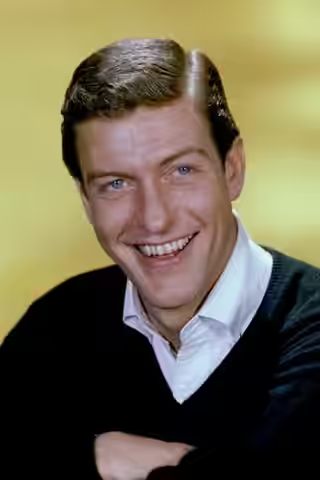
Dick Van Dyke dances with four cartoon penguins and keeps up: a comedian built for silent films who arrived a generation late and found his home in television and Disney. The accent is a footnote. The body is the act.
Fi1m perspective
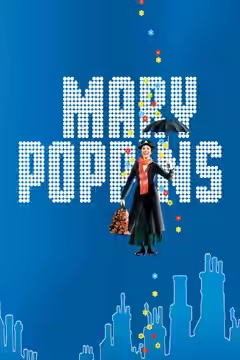
Start with Bert, the pavement artist in Mary Poppins (1964), dancing with four cartoon penguins and keeping up. He is the one thing in the frame that has not been drawn, and he moves as if he had been: the legs go somewhere the rest of him has not agreed to, and the face catches up a beat later. Everyone else in the film is working for the children. Van Dyke is the only person on screen who enjoys Mary's company as much as we do, and that is most of what he has to offer.
He came to that scene from a long way off. He started in radio and as one half of a mime and comedy act called The Merry Mutes in the late 1940s, went to Broadway as the lead in Bye Bye Birdie (1960), and then spent five years as Rob Petrie in The Dick Van Dyke Show (1961-66), with Carl Reiner writing and Mary Tyler Moore across the living room. That series is where the timing was set. Reiner's scripts split him between an office and a home, and Moore gave him someone who could spar back. The films followed: Poppins, then Chitty Chitty Bang Bang (1968), the two family musicals on which his screen reputation still rests.
What he does is older than television. The pratfalls, the limbs that seem to have a spare joint, the face that reacts a fraction after the body has: all of it comes from the silent comedians, and he does it without a trace of irony. Around it he built a persona that is hard to describe without making it sound dull. Affable, wholesome, decent, and with enough mischief that you never quite trust him to behave. That is why the Disney films work. A cleaner performer would have made Bert a saint. Van Dyke makes him a man who would rather be dancing.
Then there is the accent. In Poppins it wanders from Bow to the American Midwest and back within a line, and it has been laughed at for sixty years for good reason. It is the least of what he does. In the same film he plays the ancient chairman of Mr Banks's bank under a great deal of make-up, and the body that keeps pace with penguins is nowhere to be seen. We went back to the film expecting to smile at the vowels and found we had stopped hearing them by the second song, because a man dancing with penguins does not need to be from anywhere in particular.
He carried on. Diagnosis: Murder ran eight seasons from 1993, and in Mary Poppins Returns (2018), at 93, he turned up as Mr Dawes Jr and danced. He was still working in his hundredth year, in 2025. If you know him only from the jokes about the accent, start with Poppins and watch the legs. Nobody has found the fault in those.
Biography
Dick Van Dyke is an American actor and comedian. Born in West Plains, Missouri, he began his career in radio, nightclubs and on the Broadway stage before gaining prominence in the original production of the musical Bye Bye Birdie (1960), for which he received a Tony Award.
He starred as Rob Petrie in the CBS sitcom The Dick Van Dyke Show (1961–1966). His film roles include Bert and Mr Dawes Sr. in Mary Poppins (1964), Caractacus Potts in Chitty Chitty Bang Bang (1968), and appearances in Dick Tracy (1990) and the Night at the Museum films (2006, 2014). He later starred as Dr Mark Sloan in Diagnosis: Murder (1993–2001) and reprised a role in Mary Poppins Returns (2018).
Van Dyke has received multiple awards, including four Primetime Emmys, a Tony, a Grammy and a Daytime Emmy. He was inducted into the Television Hall of Fame in 1995.