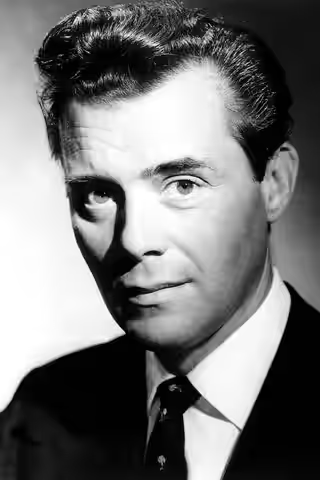
Bogarde conveyed thought with a still face and almost no expression, and the camera picked it up. The Rank matinee idol became a specialist in suave, polite men with something cruel underneath, and the mannerisms were the price.
Fi1m perspective
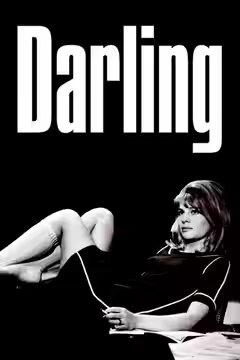
Robert Gold stops a girl in the street in Darling (1965) to ask her what it is like to be young, and spends the rest of the film deciding what he thinks of her. He speaks in finished sentences. He corrects her, forgives her, and then stops forgiving her, and Bogarde does almost none of this with his face. The tiredness under the tweed is something we noticed rather than something we were shown. His own line for it was "The camera can photograph thought," and he is one of the few actors on whom the claim holds up.
It took him a decade to be allowed to try. He was a Rank contract player through the 1950s, a matinee idol in films like Doctor in the House (1954), and the change came with Victim (1961), in which he played Melville Farr, a lawyer being blackmailed over his sexuality, a bold thing for a leading man to attempt in 1961. Then Joseph Losey cast him as Hugo Barrett, the manservant in The Servant (1963), from a Harold Pinter script, and the second career began. Losey used him four times in all, Pinter wrote for him twice, including Stephen the academic in Accident (1967), and Luchino Visconti directed him twice, including as Gustav von Aschenbach in Death in Venice (1971). He stopped after Daddy Nostalgie (1990) and did not come back.
What those directors found in him was the same thing every time: a polite surface with something cold moving under it, and the patience to let an audience find the cold for itself. His parts were servants, intellectuals and men holding something in, and the interest was never in what they said but in what they were plainly not saying. In Darling that method produces a strange effect. Robert is the film's conscience and also its worst snob, and when he finally tells Diana what he thinks of her, we found ourselves on her side, which we doubt anyone intended. Bogarde is so exact about the man's superiority that the character meant to judge her becomes the one we judge, and it is the moment the film stopped being merely well made and became interesting.
The method has a cost. The raised eyebrow, the small nervous adjustments, the stillness held a second too long: by The Night Porter (1974) some critics had begun to count them, and there were always detractors who found the later work mannered rather than fine. We would say the mannerisms are the price of the stillness, and it is not a high one. Start with Darling, where the tweed and the tiredness are both on show, and then let Losey take you the rest of the way.
Biography
Sir Dirk Bogarde (born Derek Jules Gaspard Ulric Niven van den Bogaerde) was an English actor, novelist and screenwriter. He began his career on stage in the late 1930s and served in military intelligence during the Second World War before returning to acting. He rose to prominence in the 1950s as a matinée idol in Rank Organisation films such as Doctor in the House (1954).
Bogarde later took on more challenging roles in art-house cinema, including The Servant (1963), Darling (1965), Accident (1967), Death in Venice (1971) and The Night Porter (1974). He won the BAFTA Award for Best Actor in a Leading Role for The Servant and Darling. He also wrote seven volumes of memoirs and several novels. Bogarde was appointed a Commander of the Order of Arts and Letters in 1990 and knighted in 1992. He died in 1999.