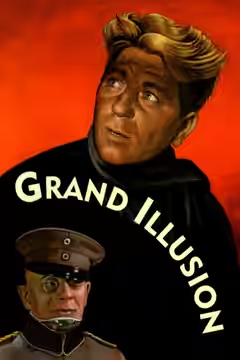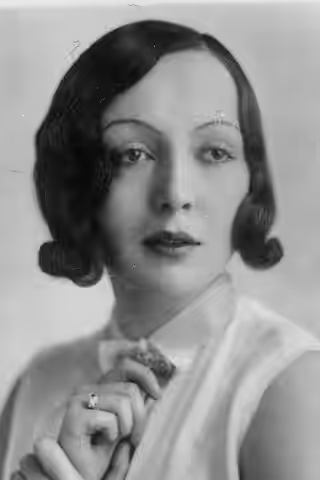
Dita Parlo learned to act before films could speak, and she never stopped acting that way: a look held a beat too long, a hand that does the talking. In two French films of the 1930s that was enough to make her last.
Fi1m perspective
Watch what Dita Parlo does with her hands. In Grand Illusion (1937) she arrives late, plays a German widow called Elsa, and says little; most of what Elsa feels is in how she sets something down or turns from a doorway. Parlo trained for the silent screen and carried its habits into sound: the glance, the pause, the line left unsaid. Renoir fills his prison camp with men who never stop talking, and he seems to have known exactly what he had in her.
The career is short and oddly shaped. She began in Germany with Homecoming (1928) and was a UFA star within a year, taking the lead in Melody of the Heart (1929), the studio's first sound film. Hollywood tried her between 1930 and 1933 and could not find a use for her; the softness that worked in Berlin did not survive the crossing into English-language leads. She went to France instead, and France gave her the two films she is remembered for: Jean Vigo's L'Atalante (1934), where she plays Juliette, and Renoir's Grand Illusion three years later.
What she does is small and it holds. In brief or supporting parts she conveys a great deal by doing almost nothing, and the critics who have written about her keep returning to the same word for it, which is gesture. We have reviewed only the Renoir, and we said there that the final stretch loses the pace the camp scenes set; Parlo is the reason it does not lose us. The camp made us laugh; Elsa made us go quiet, and we had not expected to. She said as much herself, in an interview in the late 1930s: "J’aime surtout exprimer ce qui est inexprimable, ce qui ne peut se traduire par des explications véhémentes. Il faut souvent lire au travers d’une attitude, de regards, l’expression de la personnalité." She liked, that is, to express what cannot be explained, and to have a character read through bearing and looks rather than speeches.
The limits are real. She was cast again and again as delicate, romantic or vulnerable young women, and there is no film that shows what else she might have done. The war ended her French career; she did not return to France until 1949, and after that the parts came rarely, the last of them in 1965. Erich von Stroheim, with whom she made three films, is the collaborator who appears most often in the record; Vigo and Renoir, one film apiece, are the two who count.
Start with Grand Illusion, which we have reviewed and which is the better place to meet her, since the film around her is so fine. Then find L'Atalante. Two films is not much of a career. It is more than most actors leave behind.
Biography
Dita Parlo was a German film actress. Born Grethe Gerda Kornstädt (or Gerda Olga Justine Kornstädt) on 4 September 1908 in Stettin, Pomerania, then in the German Empire (now Szczecin, Poland), she made her screen debut in 1928 and became popular in German cinema before working extensively in French films.
She is known for her roles as Juliette in L'Atalante (1934) and Elsa in Grand Illusion (1937). Parlo also appeared in Hollywood productions in the early 1930s with limited success. She married Franck Gueutal in 1949 and continued acting sporadically until 1965. She died on 12 December 1971 in France.