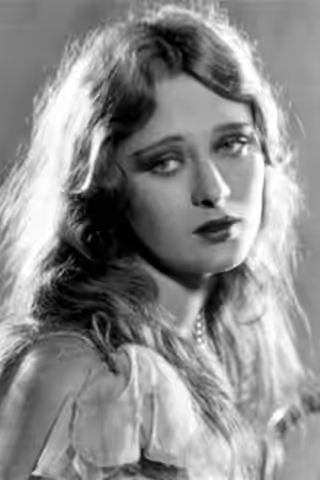
Dolores Costello did less on screen than almost anyone she shared it with, and for most of her career nobody asked for more. Orson Welles was the one director who saw what that stillness was for, and used it.
Fi1m perspective
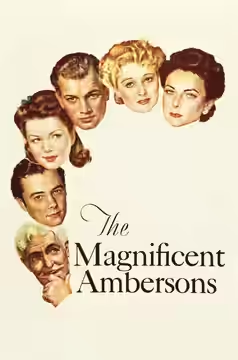
Watch Isabel Amberson Minafer take her first look at Eugene Morgan in The Magnificent Ambersons (1942), twenty years after she turned him down and married a duller man. Nothing happens on Dolores Costello's face that you could put a name to. Joseph Cotten does the talking; she does the not-quite-listening. Yet we came away certain she had never stopped wanting him, and we were moved by how little it took to tell us.
That is the whole of her method, and it was formed early. She was a child in her father Maurice Costello's Vitagraph films from around 1909 to 1915, then modelled and worked on the stage before Warner Bros. signed her in the mid-1920s. The Sea Beast (1926), opposite John Barrymore, made her a leading lady, and the studio kept casting her as patrician women subdued by love, or as innocents. What set her apart from the silent style around her was calm: she did not gesture, she waited, and the camera came to her. Michael Curtiz directed her twice. She left the screen in the early 1930s and came back only occasionally, for Little Lord Fauntleroy (1936) as Dearest Erroll, for Ambersons, and last of all for This Is the Army (1943).
The trouble with a career built on serenity is that very few parts test it. Almost nothing she was given made real demands on her as an actress; she was cast for how she looked, and the arrival of sound did not help, since a lisp had to be coached out of her before she could speak on screen. She was frank about the result. "I never was completely happy, or fulfilled, when I was devoting all my life and energies to acting," she said in one of her rare interviews, adding that she had never had much confidence in her ability.
In Ambersons we found her a little faint next to Agnes Moorehead and Tim Holt, and we stand by that. But faintness is what the part needs. Isabel is a woman the town, her son and her own good manners have slowly worn down, and Costello plays her as someone who seems already half gone. Welles wanted exactly that, and the ball sequence, with Isabel gliding through it while everyone else pushes, shows why.
The film is the one to see, and the last reel, which is not Welles's, is not her fault either. The silents made her name and The Sea Beast is where they made it, but the fuller argument for her is a Welles picture from her forties. She spent a career doubting she had much to offer. For once a director wanted precisely the thing she thought she lacked.
Biography
Dolores Costello was an American actress whose career spanned the silent and early sound eras. Born in Pittsburgh, Pennsylvania, she began as a child performer in films with her father, the actor Maurice Costello, and later appeared on Broadway with her sister Helene before signing with Warner Bros.
She achieved prominence in the 1920s as a leading lady in silent films, including The Sea Beast (1926) opposite John Barrymore, whom she married in 1928. Her later credits include Little Lord Fauntleroy (1936) and the role of Isabel Amberson Minafer in The Magnificent Ambersons (1942). She was named a WAMPAS Baby Star in 1926.