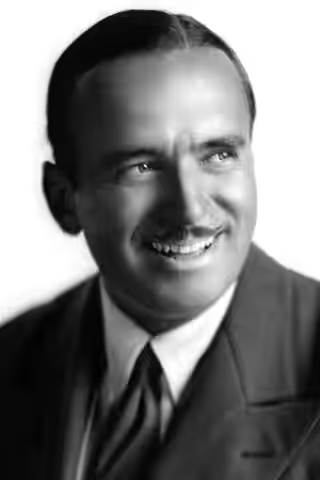
Douglas Fairbanks the producer knew how to give Douglas Fairbanks the performer room to move. We value the warmth and mischief of his adventures, though his enthusiasm for elaborate spectacle could make the storytelling leisurely.
Fi1m perspective
In The Thief of Bagdad (1924), Douglas Fairbanks moves through William Cameron Menzies’s immense sets as though their size were an encouragement. We found ourselves grinning because he seemed so cheerfully unintimidated by them. That pleasure helps explain the producer as well as the star: Fairbanks takes both story and producer credits, and the adventure is organised around his physical confidence. We recommend it despite its leisurely stretches, because his evident enjoyment makes the athletic feats feel like something more companionable than a demonstration of fitness.
The move from modern comedies to costume adventures gave him larger settings for that performance style. He formed his own production company in 1916–17 and co-founded United Artists in 1919 with Mary Pickford, Charlie Chaplin and D.W. Griffith, gaining greater control as producer, star and writer. The Mark of Zorro (1920) marks the swashbuckling turn; Robin Hood (1922), which he produced, makes the scale of those ambitions clear. By The Black Pirate (1926), those production ambitions included full-colour Technicolor.
The collaborators on Raoul Walsh’s The Thief of Bagdad make that enthusiasm for spectacle worthwhile. Menzies’s production design gives Fairbanks buildings large enough to make his freedom of movement funny, while Arthur Edeson’s cinematography lets us appreciate the performer and his surroundings together. We can enjoy what has been built without losing sight of what the star is doing. It is a persuasive example of a star producing for himself: the scenery suits his abilities, and his mischievous lightness keeps it from becoming oppressive.
His judgement about how long to keep looking is less reliable. At 149 minutes, The Thief of Bagdad asks a thin romance to sustain too much of the evening. Bill Nolan’s editing is more persuasive when movement supplies the momentum than when the story must carry us between setpieces, while Mortimer Wilson’s music makes less impression than Fairbanks’s physical timing. The pleasure of watching him remains reason enough to forgive the pauses. Start with The Thief of Bagdad, provided a brisk plot is not the evening’s first requirement.
Biography
Douglas Fairbanks was an American actor, producer and writer. He starred as the title character, produced and wrote the story (credited as Elton Thomas) for the silent fantasy The Thief of Bagdad (1924).
Born Douglas Elton Thomas Ullman in Denver, Colorado, Fairbanks began his career on the stage in New York before entering films in 1915. He became known for athletic swashbuckling roles in silent pictures such as The Mark of Zorro (1920), Robin Hood (1922) and The Black Pirate (1926). He co-founded United Artists and served as the first president of the Academy of Motion Picture Arts and Sciences, hosting its initial awards presentation.
Fairbanks was married to actress Mary Pickford from 1920 until their divorce in 1936. He died in Santa Monica, California, in 1939.