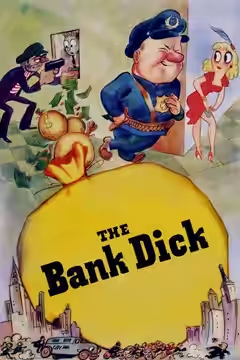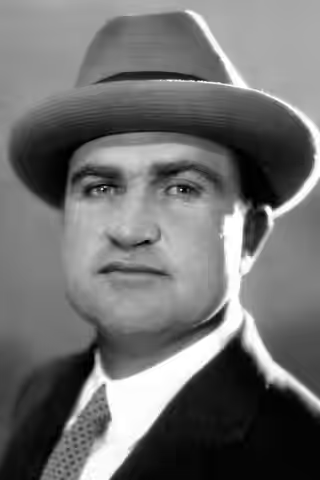
Edward F. Cline helped Keaton build physical gags and gave Fields room to talk. We value his practical feel for comedians, even if The Bank Dick also shows how little protection he offers when a routine falters.
Fi1m perspective
In The Bank Dick (1940), W.C. Fields’s speaking voice supplies much of the rhythm. Edward F. Cline gives him room, allowing individual routines to matter more than the story connecting them. We laughed at Fields’s delivery, and were happy to spend much of the film simply listening to him talk. Cline deserves credit for recognising the attraction and leaving it alone, even if that can make his own contribution difficult to pick out.
His early work with Buster Keaton involved a more visibly joint effort: the two were co-directors and gag writers on shorts including One Week (1920) and Cops (1922). Cline brought experience of physical comedy from Mack Sennett’s Keystone, and helped devise elaborate sight gags and chases. The partnership extended to the feature Three Ages (1923). These credits matter when considering a director whose contribution can be obscured by the comedian in front of him. He was helping to work out what would make a scene funny, as well as getting it filmed.
With Fields in the late 1930s, Cline was accommodating ad-libs and shaping scenes around the star’s timing. In The Bank Dick, the supporting cast gets its share of the laughs too, so the generosity is not confined to the leading man. Milton Krasner’s cinematography makes less impression than the faces, while Arthur Hilton’s editing serves individual routines better than the links between them. Charles Previn’s music likewise leaves less of a mark than Fields’s voice; there is little need for it to supply much additional rhythm. The drawback is that Cline offers few other attractions when a joke falls flat, and the loose plotting sometimes leaves us waiting for the next routine.
My Little Chickadee (1940) paired Fields with Mae West, while Never Give a Sucker an Even Break (1941) continued Cline’s collaboration with Fields. Later came comedies with Olsen and Johnson and the Jiggs and Maggie series. That is a career easily filed under the names of its stars, but the Keaton collaborations are a reminder that Cline also helped invent the comic business. Start with The Bank Dick, provided the prospect of Fields talking matters more than a tidy plot.
Biography
Edward F. Cline (4 November 1891 – 22 May 1961) was an American film director, screenwriter and actor. Born in Kenosha, Wisconsin, he began his career in 1914 at Mack Sennett's Keystone Studios, where he worked as an actor and gag writer before moving into directing.
Cline is best known for his collaborations with Buster Keaton on a series of short films in the early 1920s, including One Week (1920), Cops (1922) and The Play House (1921), and with W. C. Fields on features such as My Little Chickadee (1940), The Bank Dick (1940) and Never Give a Sucker an Even Break (1941). He also directed other comedies and worked with Olsen and Johnson.