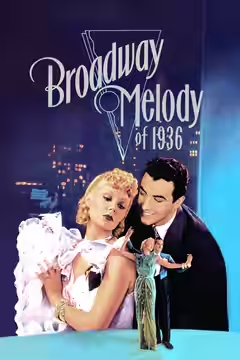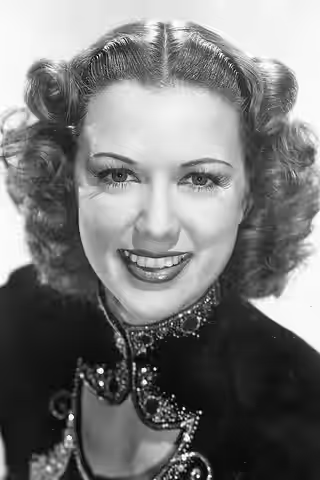
Eleanor Powell tapped harder, faster and more alone than anyone else MGM put in front of a camera, in numbers she built herself. The films around her are thin and she never pretended otherwise; when she moves, nothing else in them matters.
Fi1m perspective
Watch her feet and then watch the rest of her. In Broadway Melody of 1936 (1935) Powell taps with her whole body, arms flung wide, back arched, spinning out of a kick into a run of steps so quick the sound seems to arrive a beat behind. Charles Rosher photographs her head to toe in hard bright light and leaves the camera alone, because there is nothing to hide: the feet doing the work belong to the woman doing the smiling. She put it herself: "A tap dancer is really a frustrated drummer." That is what it looks like, percussion with a person attached.
She had been at it since childhood, first in Atlantic City nightclubs after ballet training from the age of six, then in Broadway revues from 1928, Follow Thru (1929) among them; the tap itself came late and in small doses, ten lessons with Jack Donahue and Johnny Boyle. Her film debut was George White's Scandals (1935). MGM took her the same year, gave her Irene Foster in Broadway Melody of 1936, and for eight years built musicals around her: Born to Dance (1936) put her beside James Stewart, Rosalie (1937) gave her a staircase of drums, and Broadway Melody of 1940 (1940) finally gave her a partner. She largely stopped in 1943.
The films follow one pattern, and it flatters her more than it flatters them. A leading man who cannot dance carries the plot; Powell arrives, dances, and the plot resumes without her. She devised her own routines without a choreographer, and they grew longer and grander until the numbers were swallowing everything around them, and people said so. Her singing was usually dubbed, by Marjorie Lane in the early pictures, and her acting is guileless and limited; she says the lines as written and gets on to the part she is there for. None of it was a secret and none of it stopped her.
What she lacked was a partner. Astaire and Rogers at RKO were turning dances into conversations; Powell danced alone, in exhibitions rather than exchanges, because nobody at MGM could keep up with her. Then came Astaire himself, once, in Broadway Melody of 1940, for Begin the Beguine, which most critics still count among the great tap sequences of the period. We have not reviewed it and will not judge it here, but it is where to go once you have seen what she does on her own.
On her own is how we know her. Adrian's tails and top hat for the finale of Broadway Melody of 1936 suit her better than any frock, and Rosher gives the stage a hard white shine so the tapping looks like something struck off a surface. That finale had us grinning like children, and the reason, when we found it, was plain: she is having a better time than anyone else in the building and she has earned it. Treat the films as revues, give the dialogue the attention it gives you, and put the remote down when she starts to move.
Biography
Eleanor Torrey Powell (21 November 1912 – 11 February 1982) was an American actress and dancer. She began her career on Broadway in the late 1920s and made her film debut in George White's Scandals (1935) before starring as Irene Foster in Broadway Melody of 1936 (1935).
Powell became one of MGM's leading dancers during the 1930s and 1940s, appearing in musicals including Born to Dance (1936), Broadway Melody of 1938 (1937), Rosalie (1937) and Broadway Melody of 1940 (1940). She was noted for her solo tap routines. She later appeared in archive footage in the compilation films That's Entertainment! (1974), That's Entertainment, Part II (1976) and That's Entertainment! III (1994).
She was married to actor Glenn Ford from 1943 to 1959.