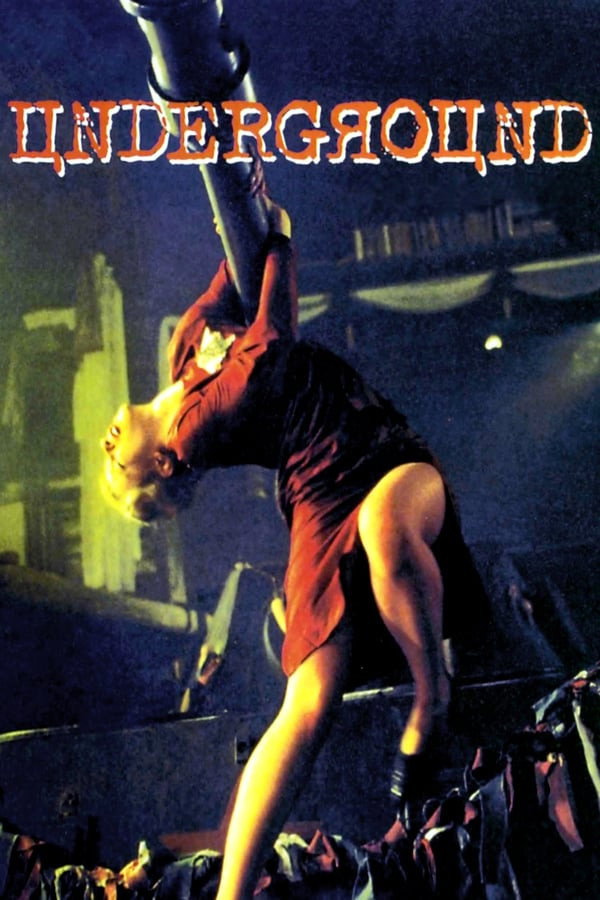
Emir Kusturica organises crowded scenes with assurance and finds cruel humour in human weakness. We recommend him cautiously: his appetite for slapstick can wear us down, and the people too often matter less than the activity around them.
Fi1m perspective
In Underground (1995), there is often so much happening within the image that following any one person becomes difficult. Emir Kusturica has the confidence to sustain these crowded scenes, and there is considerable pleasure in watching him organise them. Slapstick makes heroic behaviour look ridiculous, giving the bustle a purpose beyond keeping us entertained. We recommend the film cautiously, because he also keeps sequences going beyond the point at which their jokes have done their work.
Do You Remember Dolly Bell? (1981), his first feature, draws on Sarajevo youth. When Father Was Away on Business (1985) looks at 1950s Yugoslavia through a child’s eyes. With Time of the Gypsies (1988), Roma lives and the combination of tragedy and farce become central to his cinema. After the US-made Arizona Dream (1993) and Underground, Black Cat, White Cat (1998) turns to screwball comedy, returning to Roma life.
In Underground, cinematographer Vilko Filač makes the elaborate action absorbing even when the story is hard to follow. Miljen ‘Kreka’ Kljaković’s production design gives Kusturica the scale his crowded scenes need. The director knows how to use that space, sustaining passages whose sheer amount of activity might defeat a less assured organiser. The difficulty is that we sometimes become more interested in looking at everything than in following what anyone is doing.
The screenplay, written with Dušan Kovačević, finds its strongest material in black-comic subplots, where deceit produces situations worth watching. We laughed at the slapstick in Underground, then grew tired as sequence after sequence returned to the same noisy pitch. The cruel humour sometimes makes the suffering harder to dismiss, and those moments give the comedy a seriousness its delivery can disguise. Too often, though, exaggerated behaviour leaves the characters difficult to care about.
His work with non-professional actors in Time of the Gypsies shows that he can give performances the attention they need. In Underground, the appetite for more action too often takes over, and 170 minutes is a long time to spend wishing a director would stop adding things. Try it for the black comedy and the staging, provided a few stretches of impatience will not spoil the evening.
Biography
Emir Kusturica is a Bosnian-born Serbian film director, screenwriter, actor and musician. He studied at the FAMU film academy in Prague, graduating in 1978, and began his career directing for television in Sarajevo before making his feature debut with Do You Remember Dolly Bell? (1981).
Kusturica is known for films including When Father Was Away on Business (1985), Time of the Gypsies (1988), Arizona Dream (1993), Underground (1995), for which he also wrote the screenplay, Black Cat, White Cat (1998) and Life Is a Miracle (2004). He won the Palme d'Or at Cannes twice, for When Father Was Away on Business and Underground. Since the mid-2000s his primary residence has been Drvengrad, a village in Serbia that he developed from sets built for Life Is a Miracle.