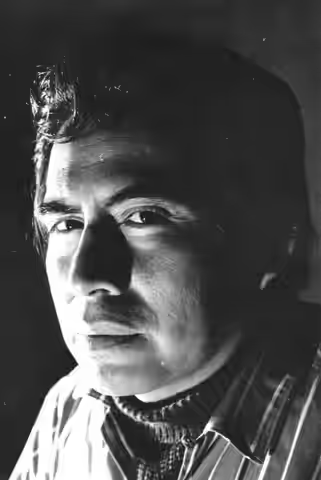
A Mexican character actor who spent nearly six decades playing the men who run things: patriarchs, governors, bishops, bosses. In El Norte he has a handful of scenes, and Arturo is the only man in them who seems to know what is coming.
Fi1m perspective
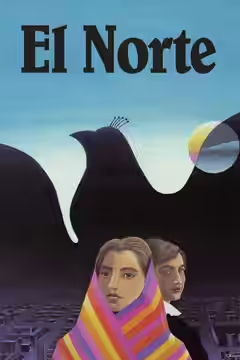
The soldiers arrive in El Norte (1983) and Gregory Nava keeps the violence mostly at the edge of the frame. What he keeps in the middle of it is Ernesto Gómez Cruz. Arturo has only a few scenes, and Gómez Cruz plays him with a tired, level intelligence, a man who has already worked out what speaking up will cost and speaks anyway. We found we were watching his face rather than the door, waiting for it to change, and it never did. The film runs on a long way after he leaves it and is never as sure of itself again.
That steadiness was his trade, and he had it from the start. He arrived in Los Caifanes (1967) as El Azteca, and the 1970s made him a fixture of the committed and satirical Mexican cinema of the decade, most often remembered for Lucas in Felipe Cazals's Canoa (1975). He spoke of the period warmly: "Para mí como actor la década del setenta fue maravillosa. Hice cine de todo tipo: de arte, comercial, melodramas, comedias." Then came Arturo Ripstein, who used him three times, as Cabo Pantoja in the prison drama Cadena perpetua (1979) and as Dionisio Pinzón in El imperio de la fortuna (1986), and Jorge Fons, who gave him Don Rutilio in El callejón de los milagros (1995).
The later phase belongs to Luis Estrada, four films, with Damián Alcázar usually somewhere in the frame. Gómez Cruz was the Gobernador in La ley de Herodes (1999) and Don José Reyes, a crime boss, in El infierno (2010), and between the two he was the bishop in El crimen del padre Amaro (2002). Look at that list and the type is plain: the men in charge, and mostly the wrong men. He was cast for authority and for the sense that the authority had gone off, though he could also be, when a film wanted it, a working man, a priest or a fool in a comedy. Mexican critics have never had much bad to say about him, and we cannot find much either.
The one thing we would say against a career like this is that it is scattered. A supporting actor is at the mercy of the film around him, and a face that means the state or the church before it has spoken is a face a lazy director can lean on. His own account of the job, that you study what a character is rather than memorise his lines or nothing credible comes out, suggests he knew the risk.
He died in April 2024 at ninety, one of the last actors with a foot in the old Mexican cinema. Start with El Norte, and notice how much of its best hour rests on a man with a few scenes and a level voice. Then go to Estrada, where the same authority is turned to satire.
Biography
Ernesto Gómez Cruz was a Mexican actor. He played Arturo in the 1983 film El Norte and appeared in various roles in the 1988 television series The Marked Hour.
Born on 8 November 1933 in Puerto de Veracruz, Mexico, he died on 6 April 2024 in Mexico City. He initially worked as a photographer before studying dramatic art at the Instituto Nacional de Bellas Artes. His screen debut was in Los Caifanes (1967).
Gómez Cruz appeared in more than 150 films. Among his credits are Herod's Law (1999), The Crime of Padre Amaro (2002), El Infierno (2010) and The Perfect Dictatorship (2014). He received seven Ariel Awards, including the Ariel de Oro for his career in 2014, and also worked in television series such as Capadocia (2008).