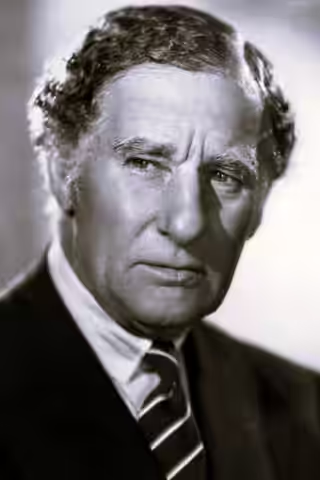
A Broadway acrobat and clown who came to sound films in his sixties and played tired, decent fathers. In Alice Adams (1935) he is better than the leading man, and most of what made him famous never reached a camera.
Fi1m perspective
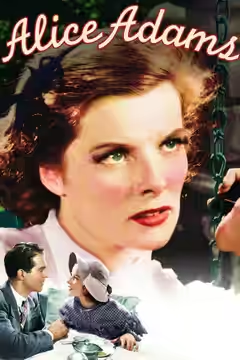
Fred Stone's Virgil Adams sits at the family table in Alice Adams (1935) and lets his wife talk. Ann Shoemaker's Mrs Adams wants more for their daughter, and Virgil is a tired, decent man who would rather not want anything, nagged into ambition he does not feel. Stone plays him as somebody who lost the argument years ago and has stopped expecting to win it. Fred MacMurray, the young man Katharine Hepburn is performing for, is pleasant and a little blank; Stone gives the better performance, and the family rows he is caught in are the truest scenes in the film.
He arrived at that table by an odd road. Stone began in circuses and minstrel shows in the 1880s, formed a vaudeville and Broadway partnership with Dave Montgomery in the 1890s that ran until Montgomery's death in 1917, and created the Scarecrow in the original stage production of The Wizard of Oz in 1902. He was an acrobatic dancer, a singer and a comedian long before he was anything a film would call an actor, and he stayed on Broadway, on his own, into the mid-1940s. Films were the sideline. There were silent comedy westerns from 1918, then nothing much until the sound era, when he came back in his sixties in supporting parts from 1935 and stopped in the early 1940s. About nineteen features in all, most of them small.
What the camera got was the residue. In the sound years he was cast as ordinary, put-upon fathers and older men: Judd Tolliver in The Trail of the Lonesome Pine (1936), an early Technicolor western, and Caliphet Mathews in The Westerner (1940), third-billed under Gary Cooper. Reviewers at the time noticed that he could carry humour and pathos in the same body, in a kitchen or a small town, and that is exactly what Virgil is: a man who is faintly funny in his exhaustion and then, a line later, not funny at all. We felt more for him than for anyone else in the film, Hepburn included, and it is because Stone never asks for it. He does not plead. He looks worn, and Shoemaker keeps talking, and the scene does the rest.
The frustration is that the films are the least of him. Nearly everything his contemporaries praised, the tumbling, the singing, the eccentric comedy of Jack o' Lantern (1917) and Stepping Stones (1923), happened on stages and is gone. Watch Alice Adams for Hepburn, then watch the man at the end of the table, and know that you are seeing the quiet end of a career that was mostly loud.
Biography
Fred Andrew Stone was an American stage and film actor. He began performing in circuses and minstrel shows, then formed a long-running vaudeville partnership with David Montgomery. The pair starred together on Broadway in productions including the 1903 extravaganza The Wizard of Oz, in which Stone played the Scarecrow.
Stone made his feature-film debut in 1918 and appeared in around 19 films. He played Virgil Adams in Alice Adams (1935) and Caliphet Mathews in The Westerner (1940). He received a star on the Hollywood Walk of Fame.