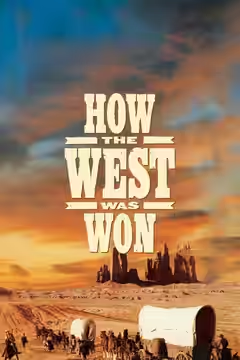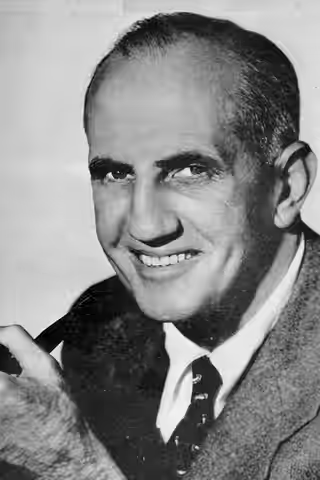
George Marshall directed comedies, Westerns and the odd thriller for fifty years, most of them capably and none in a way you would recognise as his. His railroad chapter of How the West Was Won is typical: loud, handsome, well organised and never frightening.
Fi1m perspective
In the railroad chapter of How the West Was Won (1962), a herd of buffalo comes through a railhead camp, and it goes on for a long time. Henry Fonda is on hand as Jethro Stuart, a buffalo hunter who has seen what is coming, and the Cinerama screen is as wide as it ever gets. This is George Marshall's share of a film that had three directors, and it is the most useful thing we can point to when asked what he was like. The stampede is loud and well organised and we admired the planning of it. We were never once frightened, and a herd of buffalo running through a camp full of people ought to manage that.
He had been at this for a long time. He arrived in Hollywood around 1912 as an extra and stuntman, was directing shorts and Westerns by 1916 with Harry Carey and Tom Mix, and spent the 1930s on features, among them Laurel and Hardy comedies at Roach. The good years came at Universal and Paramount: Destry Rides Again (1939), which put Marlene Dietrich back to work, The Ghost Breakers (1940) with Bob Hope and Paulette Goddard, and The Blue Dahlia (1946), a noir with Alan Ladd from a Raymond Chandler script. In the late 1950s he was making Glenn Ford pictures at MGM, starting with The Sheepman (1958). By the end of the 1960s he was mostly working in television.
That list is the case for him, and it is also the case against. Comedies, Westerns, a noir, a horror-comedy: he did whatever the studio needed, and the stars came back. Six films with Hope, six with Ford, five with Jerry Lewis, four with Goddard. Actors do not return to directors who waste their time. What critics have never found in him is a subject or a style of his own, and we cannot find one either; the reputation is of a reliable craftsman, and the one stretch of his work we have reviewed bears it out. In the same film, Henry Hathaway's train robbery and John Ford's Civil War chapter are the parts we told readers to stay for. Marshall's is part of the parade.
He knew this about himself, or near enough. "If you're a mechanic you just do it as written. If you're – I wouldn't say an artist – then you try to make more of it," he said of the job, and the hedge in the middle is the honest part. He made more of it than a mechanic would. He did not make it his own. If you come across one of his comedies on a wet afternoon, you will probably have a pleasant time and will not remember who directed it. That is what he did for fifty years, and the studios kept asking.
Biography
George Marshall (1891–1975) was an American film and television director, actor, screenwriter and producer. He worked across six decades of cinema, beginning in the silent era with Westerns before moving into a range of genres.
He is known for directing Destry Rides Again (1939), The Ghost Breakers (1940), The Blue Dahlia (1946), Houdini (1953), The Sheepman (1958) and the railroad segment of the Cinerama epic How the West Was Won (1962), which he co-directed with John Ford and Henry Hathaway. Later in his career he directed several comedies starring Bob Hope and Jerry Lewis. Marshall received a star on the Hollywood Walk of Fame for his contribution to the film industry.