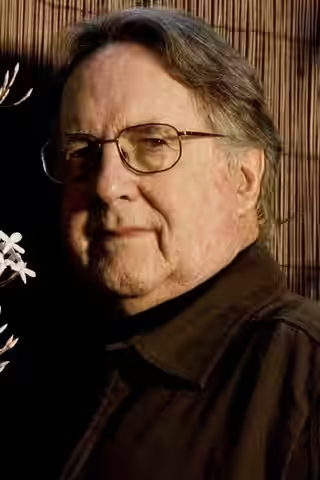
A theatre director who came to film in his fifties and never stopped being one. George Ogilvie's screen work is quiet, actor-led and short on spectacle; his best-known film is the one where somebody else handled the spectacle.
Fi1m perspective
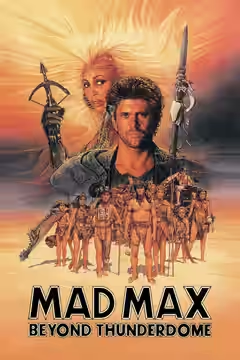
Mad Max Beyond Thunderdome (1985) is a film in two halves, and it plays like a film with two directors, because it is one. The first half is Bartertown: a city of scrap and rope, run on pig manure, with Tina Turner on the balcony. The second half is gentler, slower and more interested in people talking. We gave it 65 and said the first half was worth anyone's evening and the second was for the patient. The second half is the George Ogilvie half. He was brought in to handle the dialogue and the drama while George Miller took the action, and the join shows.
That was his first feature, and he was fifty-four. He had spent thirty years in the theatre by then: an actor in Australia and Britain in the 1950s, trained at RADA and in mime under Jacques Lecoq, then a director from the 1960s, with six years as associate director of the Melbourne Theatre Company and a stint as the first artistic director of the State Theatre Company of South Australia. Television came in the early 1980s with The Dismissal and Bodyline. Film came late, and it came through Miller, with whom he made three pictures.
He knew what he was. "Good actors know what they're doing, so you just put the camera on them. I have always believed they know more than most directors think they know. What I do as a director is give them the world to work in," he said in 2016. His films bear that out. The Crossing (1990) gave Russell Crowe his first feature. The Shiralee (1987) put Bryan Brown and Noni Hazlehurst in a miniseries that people still speak well of. Short Changed (1986) is an inter-racial custody drama, The Place at the Coast (1987) a domestic drama with a reputation for intelligence, and both are about the kind of people he said he loved working on: battlers, the ones at the edge. We have not reviewed them and will not pretend to. What we can say is that the reputation is consistent, and it is for performances, not pictures.
That is also the limit. A director who puts the camera on the actors and waits is only as good as the actors and the scene, and in the one film of his we have written about, the scene runs out. We felt Thunderdome go slack the moment it turned quiet, and we were a little sorry about it, because the people in the quieter half are plainly being watched by someone who cares for them more than the story does. The account of his early stage work is that he interfered too much and learned to stand back. On screen he may have learned it too well.
He did not put himself between the audience and the actor, which is a virtue, and he did not put much else there either. See the first hour of Thunderdome for Miller and Turner. Stay for the second if you want to know what Ogilvie did, and decide for yourself whether the film needed a second director or a shorter script.
Biography
George Ogilvie was an Australian theatre, film and television director and actor. Born in Goulburn, New South Wales, he trained at the Royal Academy of Dramatic Art in London and began his career as an actor before moving into directing.
He served as founding artistic director of the State Theatre Company of South Australia and directed numerous stage productions, operas and ballets. In film and television he co-directed Mad Max Beyond Thunderdome (1985) with George Miller and directed features including Short Changed (1986), The Place at the Coast (1987) and The Crossing (1990).
Ogilvie was appointed a Member of the Order of Australia in 1983 for services to the performing arts. He died in Braidwood, New South Wales, in 2020.