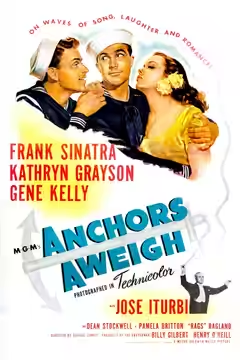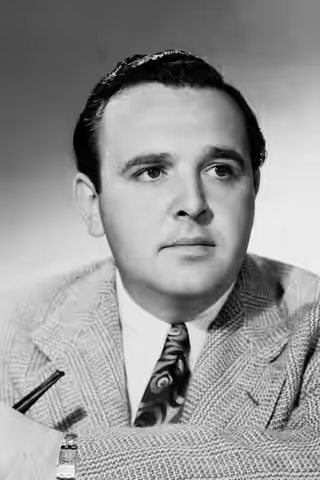
George Sidney was the MGM man who could stage anything: a sailor dancing with a cartoon mouse, a riverboat in Technicolor, a sword fight. The numbers are still as good as the studio musical got. What sat between them was never really his concern.
Fi1m perspective
The moment everyone remembers from Anchors Aweigh (1945) is Gene Kelly dancing with Jerry the Mouse, a live man and a drawn one sharing a floor and, apparently, a sense of rhythm. William Hanna and Joseph Barbera drew the mouse; Sidney had to make the two halves of the frame agree, and they do. We went in expecting a curiosity and found ourselves grinning, because Kelly treats the mouse as a partner who might miss a step, and after a minute the trick stops being a trick. That is the kind of director Sidney was. Set him a problem of staging and he solved it, cleanly and without fuss, and moved on to the next.
He came up through the building. He started at MGM as a messenger boy at about sixteen, moved into editing and then shorts, including the Our Gang comedies, and directed his first feature in 1941. Of that assignment he later said, "Nobody else on the lot would do it." Through the 1940s and 1950s he made the studio's big Technicolor musicals with its biggest casts: Thousands Cheer (1943), The Harvey Girls (1946) with Judy Garland, Show Boat (1951), Kiss Me Kate (1953), shot for 3D. He left MGM in the mid-1950s for Columbia and independent work, made Bye Bye Birdie (1963) and Viva Las Vegas (1964), both with Ann-Margret, and stopped after Half a Sixpence (1967).
What worked was the number. Give him a crowd and a soundstage and he knew where to put the camera and how long to keep it moving; The Harvey Girls is remembered for a camera that will not stand still. He could do a duel as well as a dance, and Scaramouche (1952) has the same hand on it. He worked with Kelly four times and Kathryn Grayson three, and in Anchors Aweigh he gave Kelly three numbers we called as good as the studio musical ever got.
What did not work was everything else. That film runs 143 minutes and Isobel Lennart's screenplay is, as we said, a clothesline; Sidney hangs the washing beautifully and does not seem to notice how far apart the pegs are. The 1960s films are often thought heavy with production and short of the old zest, and that is the same fault seen from the other side. Critics have never put him beside Vincente Minnelli, though some of his numbers are as inventive as anything Minnelli staged. We think the ranking is about right. The numbers are not the problem; the film around them is, and he let it go slack every time.
Start with Anchors Aweigh, and sit through the sailor-suit plot for the sake of the mouse and the two Kelly solos. The good parts are worth the wait. The wait is long.
Biography
George Sidney (4 October 1916 – 5 May 2002) was an American film director and producer who worked primarily at Metro-Goldwyn-Mayer. Born in Long Island City, New York, he joined MGM as a messenger boy in his teens and progressed to editing and directing shorts, including several Our Gang comedies and Pete Smith specials.
He directed his first features in the early 1940s and became known for large-scale musicals such as Anchors Aweigh (1945), The Harvey Girls (1946), Annie Get Your Gun (1950), Show Boat (1951) and Kiss Me Kate (1953). Later credits include Pal Joey (1957), Bye Bye Birdie (1963) and Viva Las Vegas (1964).
Sidney served as president of the Screen Directors Guild and its successor, the Directors Guild of America. He received a star on the Hollywood Walk of Fame and was nominated four times for the Directors Guild of America Award.