George Sluizer made one thriller that tells you the answer first and frightens you anyway, then spent much of what followed in its shadow, including a Hollywood remake of it that changed the ending. The Vanishing (1988) is enough to be going on with.
Fi1m perspective
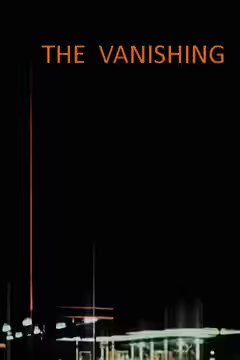
A woman goes into a motorway shop for drinks and does not come out. George Sluizer holds on the doors, and on Gene Bervoets by the car looking at them, then at his watch, then at them again, and he does not cut to a hand or a van or anything else that would tell us what has happened. We watched that scene in The Vanishing (1988) without breathing properly and did not notice until it was over. Nothing moves, and that is why. It is the plainest idea in Sluizer's work and the best one: film the ordinary thing in ordinary light and let the audience do the rest.
He got there slowly. He trained at IDHEC in Paris in the mid-1950s, assisted Bert Haanstra, and spent the 1960s on documentaries and shorts. The features, when they came, were João en het mes (1972), shot in Brazil, and Twee vrouwen (1979), and like most of what followed they were made across borders and in more than one language; he had spoken several since childhood. Then Spoorloos, which he co-wrote with Tim Krabbé from Krabbé's novel, produced, directed and cut himself. It is the film that got him noticed outside the Netherlands, and it is the one everything after it is measured against.
What he did well in it he did by method. Toni Kuhn lights the service station like a holiday snapshot, Lin Friedman's cutting never hurries, and Krabbé's killer is given a long, calm account of himself on a car journey that Donnadieu makes sound reasonable from the first word to the last. Sluizer said of the film that he believed only in grey, not in black or white, and it shows: the man in the cardigan is not a monster with a theme tune, he is a neighbour who has done his homework. That is what makes the film hard to shake, and it is a harder trick than any amount of blood.
Then Hollywood. He remade the film for 20th Century Fox in 1993 and changed the ending, and the remake is widely thought the poorer for it. We have not reviewed it and will not judge it at length, but it is a strange thing for the man who built the first ending to have agreed to. He said afterwards that a director starting out in Hollywood is simply an employee. Utz (1992), from Bruce Chatwin, kept his habit of working from novels; Crimetime (1996) and The Commissioner (1998) came and went with little notice. Dark Blood, begun in 1993 and stopped when its lead, River Phoenix, died, he finished himself in 2012, which tells you something about his patience.
Watch the Dutch one, on a night when you do not have to drive anywhere afterwards. It is the work of a man who understood that the most frightening thing you can show an audience is a pair of doors that stay shut. He did not get to show it twice.
Biography
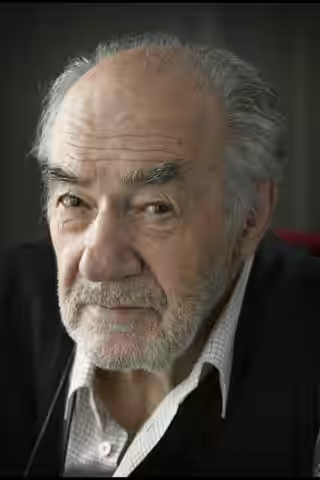
George Sluizer (1932–2014) was a Dutch filmmaker who directed, wrote, edited and produced feature films and documentaries. Born in Paris to Dutch and Norwegian parents, he began working in film in the 1960s and remained active until his death.
He is best known for The Vanishing (1988), originally released in Dutch as Spoorloos, on which he served as director, co-writer, editor and producer. Sluizer also directed the 1993 American remake. Other feature films he directed include Utz (1992), Crimetime (1995) and Dark Blood, which was completed and premiered in 2012 after being halted by the death of its lead actor River Phoenix in 1993.