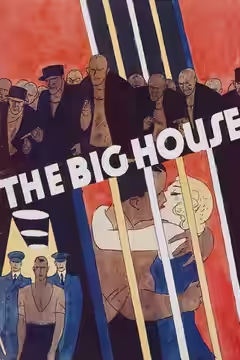
George W. Hill made films about crowds of men in confined places, and he let us hear them before he let us see them. The Big House (1930) is the proof, and a career that had barely begun in sound was over four years later.
Fi1m perspective
Boots on stone, all together. In The Big House (1930) three thousand men march to meals in a prison built for eighteen hundred, tin plates go down on the tables in one clatter, and there is almost no music to soften any of it. George W. Hill had come up behind the camera, and yet the film he is remembered for is remembered for its sound. He worked out what the microphone was for, which was to tell us how big the room was and how many people were in it, at a time when most directors were still using it to record people saying hello.
He had been in the business since he was thirteen, as a stagehand for D.W. Griffith, and he shot silent features before he began directing in the early 1920s. At MGM he made Tell It to the Marines (1926) with Lon Chaney, then The Big House and Min and Bill, both in 1930, and Hell Divers (1931), a naval aviation picture. We have reviewed only the prison film, so we will not pretend to judge the rest, but the pattern is plain from the titles: barracks, cell blocks, flight decks. Hill liked places where men are counted, lined up and made to wait.
What he did with such places was keep the frame stark and the light low. Harold Wenstrom's camera in The Big House sits in a black corridor while men in the punishment cells talk to each other through the walls, and Hill trusts the voices to do the work. We came to the film expecting a museum piece and were unnerved by that scene, more than by the gunfire that follows, because Hill asks us to imagine what we cannot see and the imagining is worse. The riot in the last reel is staged as a siege, cut cleanly between the yard and the warden's office, with the microphone again carrying half of it.
His best collaborators understood the same thing. Frances Marion wrote three films for him, including The Big House, and gave him plots thin enough to leave room for the building. Wallace Beery made three with him too, and Hill kept putting him in doorways so that he filled them, letting Butch be a murderer, a bully and a child in the same sentence. Chester Morris and Robert Montgomery play smaller and stiller beside him, which is the right instinct: one enormous man, two quiet ones, and the walls.
The weakness is the world outside. The love story bolted onto The Big House is dead weight, and Hill seems to know it; he is a director of crowds and confinement, not of two people in a parlour. He died in 1934 with The Good Earth still on paper, so we have a handful of sound films and no idea what a decade more of them would have taught him. Start with The Big House, and when it leaves the prison, feel free to wait for it to go back in. Hill would have understood.
Biography
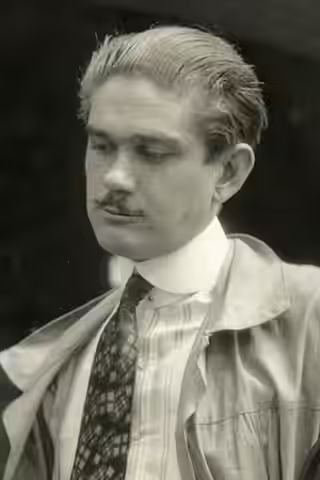
George W. Hill (also credited as George Hill) was an American film director and cinematographer. Born on 25 April 1895 in Douglass, Kansas, he began his career at the age of 13 as a stagehand for D. W. Griffith and progressed through cinematography and screenwriting before directing his first features in the early 1920s.
Hill directed a number of silent and early sound films for major studios, including Tell It to the Marines (1926) and The Big House (1930), the latter a pre-Code prison drama regarded as one of his major works. He also contributed as second assistant director to Intolerance (1916). His later films often featured stark, realistic atmospheres.
Hill was married to screenwriter Frances Marion from 1930 until their divorce in 1933. He died on 10 August 1934 in Venice, California.