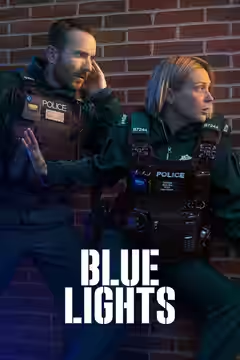
Gilles Bannier makes police drama tense by keeping his characters’ uncertainty visible. We rate his patient attention to ordinary officers in Blue Lights, even when the programme explains more than it needs to.
Fi1m perspective
The recruits in Blue Lights (2023) do not stop looking inexperienced when the danger arrives. Gilles Bannier keeps their uncertainty visible, so we worry about their judgement without waiting for a hidden threat to be revealed. We were anxious for them because the work was becoming dangerous while they were still learning how to cope. This is tense, humane direction, willing to spend time with ordinary officers rather than hurry them towards the next incident. Familiar police situations become worth watching because the people facing them do not yet look sure of themselves.
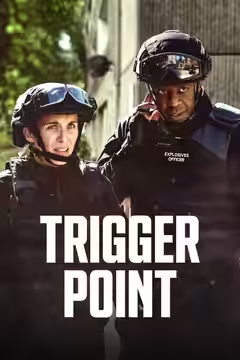
His attention to real environments has roots in documentaries for ARTE, which preceded his move into drama. Credits on Reporters (2007–09), the second series of Spiral (2008) and Les Beaux Mecs (2011) were followed by work in British television. That work includes The Tunnel (2013), Tin Star (2017) and Trigger Point (2022). He favours character-led stories over intricate plotting, a useful preference when the procedures could so easily become more important than the people carrying them out.
On Blue Lights, he directed all six episodes, and the result is a welcome steadiness of tone. His preference for real locations makes sense for a drama so concerned with the conditions in which people work. Belfast gets attention as a particular place, with local details that a generic police setting would lose. Bannier’s outsider perspective is useful here, helping him avoid familiar clichés about the setting while leaving the officers at the centre.
Writers Declan Lawn and Adam Patterson are among his collaborators, and we should not give direction sole credit for characters worth following. The limits are visible in Blue Lights, too: the rookie viewpoint sometimes makes the explanations conspicuous. We notice when we are being briefed, but the performances give these familiar situations enough weight to keep us involved. Start with Blue Lights, allowing for the occasional lesson in police work.
Biography
Gilles Bannier is a French director. He began his career directing documentaries for ARTE in France before moving into drama.
Bannier has directed episodes of several British and French television series, including The Tunnel (2013–2018), Tin Star (2017–2019), In the Dark (2017), Marcella (2020), Trigger Point (2022) and all six episodes of Blue Lights (2023). His feature film Stop Me Here (2015, also known as Arrêtez-moi là) received the Prix du jury jeunes at the Festival du film de Sarlat.
In 2024 he became Creative Director of Alef UK, a London-based production company developing high-end scripted drama.