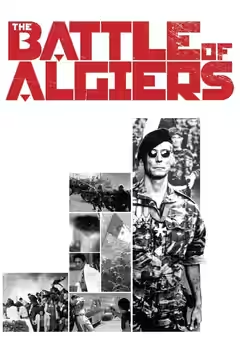
Pontecorvo gives organised revolt the pace of a thriller while keeping the suffering in view. The Battle of Algiers earns our strongest recommendation, though his attention to a campaign can leave too little time for its people.
Fi1m perspective
In The Battle of Algiers (1966), Pontecorvo makes us follow the organisation, the attacks and the retaliation. The black-and-white images and newsreel manner make the violence feel uncomfortably close. We were horrified by the torture because he keeps our attention on the suffering rather than letting us treat it as another stage in the campaign. It is a war film we recommend even to people who usually avoid them, with a firm warning about its cruelty.
His features began with the fishermen of The Wide Blue Road (1957), before Kapò (1960) brought a turn towards political drama. Documentaries and shorts had preceded them, and the documentary habit remained central to his cinema. Handheld cameras and mostly non-professional actors helped him make reconstructed events look caught rather than arranged. By The Battle of Algiers, that method could sustain a thriller's pace without making the suffering incidental. The later Ogro (1979) continued his interest in organised violence, but Algiers remains our starting point.
Ennio Morricone and Pontecorvo's music for The Battle of Algiers is central to why that film works. Its mournfulness checks the temptation to become absorbed in the tactics and gives us time to register their cost. Sometimes the score pushes us to feel what the photography has already made plain, and we notice the insistence. More often its sadness is necessary, particularly in a film that moves so briskly through the mechanics of a campaign and might otherwise let us forget whom it hurts.
The reservation is that he can give an operation more attention than the people caught in it, leaving too little time to know them beyond their place in the fighting. That limits The Battle of Algiers, though it does not undo its compassion for civilians or its bluntness about violence on opposing sides. The film supports the independence struggle without asking us to excuse the violence committed in its name. Start with The Battle of Algiers; save it for an evening when comfort is not the priority.
Biography
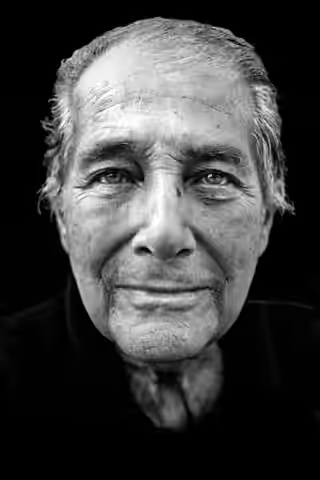
Gillo Pontecorvo was an Italian film director, screenwriter and composer. Born in Pisa in 1919, he died in Rome in 2006. He is best known for directing, writing the story for and co-composing the music of The Battle of Algiers (1966).
Pontecorvo trained as a chemist before working as a journalist. He joined the Italian Communist Party in 1941 and took part in anti-fascist resistance during the Second World War. He began in cinema as an assistant director in the early 1950s and made his first feature, The Long Blue Road, in 1957. His other notable films include Kapò (1960) and Burn! (1969).
The Battle of Algiers won the Golden Lion at the Venice Film Festival and received Academy Award nominations for best director and best original screenplay.