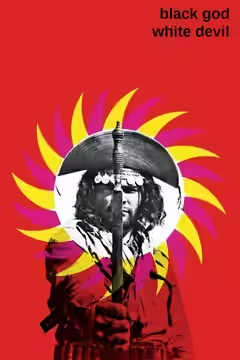
Glauber Rocha made films that shout: handheld camera, black and white pushed to chalk and soot, ballads cut against orchestras, bandits and prophets who turn and argue with the audience. Black God, White Devil (1964) is the one to start with, and the noise is most of the point.
Fi1m perspective
In Black God, White Devil (1964) a cowherd kills his boss with a machete inside the first ten minutes, and Rocha does not let him, his wife or us sit down for two hours. That is how a Rocha film goes. The camera is handheld, the black and white is high in contrast, a long take gives way to a burst of cutting, a popular ballad is followed by an orchestra, and every so often somebody stops and talks straight at us, half fever and half lecture. Nobody had put the Brazilian north-east on screen with this much anger.
His first feature, Barravento (1962), was closer to neorealism than anything that followed. The run that made his name came next: Black God, White Devil (1964), Entranced Earth (1967), and Antonio das Mortes (1969), in colour, which brought back Maurício do Valle's hired killer. In 1965 he published the manifesto "An Aesthetics of Hunger": "Our originality is our hunger, and our greatest misery is that this hunger, while it's felt, is not understood." From 1971 he worked in Europe, Africa and Cuba, and came home late in the decade to make The Age of the Earth (1980), a fragmented attempt at myth and imperialism, finished the year before he died.
What works is the look and the sound. Waldemar Lima, his cinematographer on two films, shot the dry scrub in a black and white so hard that the film is thrilling to look at, and Paulo Gil Soares and Walter Lima Jr., who share the writing credit on Black God, White Devil, helped him build a story that borrows the shape of a Western, a gunman crossing flat country after a fugitive, and then refuses the Western's rewards. His people are emblems rather than characters: bandits, hired killers, preachers, intellectuals, all changing sides as the argument requires. We came out of Black God, White Devil exhilarated and a little battered, and both were what Rocha meant; the film is loud for two hours and louder in the second.
The flaw is the virtue turned up too far. When the ballad, the orchestra and the monologue arrive together, the argument about landlords, the Church and what the poor are offered instead of land goes under. Critics on the left at the time found Entranced Earth too apocalyptic and not didactic enough; others have found Antonio das Mortes hard to follow on a first viewing. We understand both complaints, though we would not swap the noise for clarity. The one man in Black God, White Devil who speaks quietly is do Valle's Antônio das Mortes, and it is no accident that Rocha gave him a film of his own five years later.
Start with Black God, White Devil. Watch it at home, where the shouting is easier to sit through, and do not expect it to let you rest.
Biography
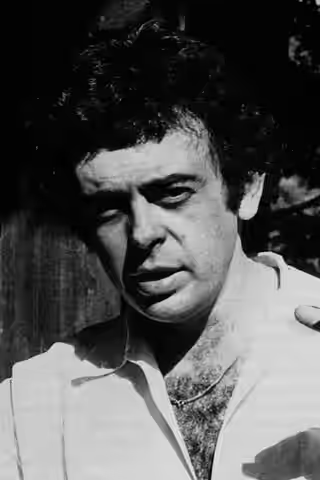
Glauber Rocha was a Brazilian film director, screenwriter and producer. Born in Vitória da Conquista, Bahia, he began making short films in the late 1950s and directed his first feature, Barravento, in 1962 before moving to Rio de Janeiro.
He became a central figure in the Cinema Novo movement. His best-known works include the 1964 film Black God, White Devil (also known as Deus e o Diabo na Terra do Sol), for which he served as director, writer and editor; Entranced Earth (Terra em Transe, 1967), which he directed, wrote and produced; and Antonio das Mortes (1969). Entranced Earth won the FIPRESCI prize at Cannes and Antonio das Mortes won the festival's Best Director award.
Rocha died in Rio de Janeiro in 1981.