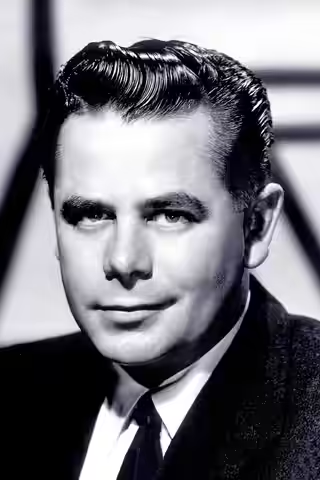
Glenn Ford built a career on doing next to nothing on screen and making it register. He played ordinary men under pressure in Westerns, thrillers and classrooms, and he was best when the film trusted him to keep his voice down.
Fi1m perspective
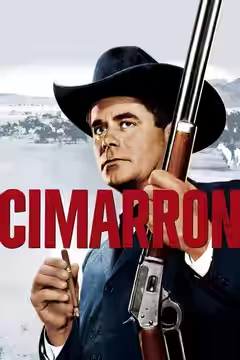
In Cimarron (1960) Glenn Ford plays Yancey Cravat as a man who cannot stay in a room. He is courteous to everyone and reliable to no one, and he keeps leaving, and Ford does not make any of it charming. Most leading men of his generation would have asked us to forgive Yancey. Ford lets us see what his wife sees, which is a door closing. We were irritated with the man by the second hour, and then realised Ford had built the irritation on purpose, one polite exit at a time, and had not asked to be liked for it.
That is the method, and it took a while to find a home. He signed to Columbia in 1939 and spent the early years in B-pictures and supporting parts, went away to the Marines from 1942 to 1945, and came back to Gilda (1946), opposite Rita Hayworth, and was a star by the end of it. He and Hayworth made five films together. Through the 1950s and 1960s he was the studio's ordinary man in an unusual spot, across Westerns, noir, drama and comedy: the detective in The Big Heat (1953), the teacher in Blackboard Jungle (1955), and, less typically, the outlaw Ben Wade in 3:10 to Yuma (1957), for Delmer Daves, who directed him twice and got a performance most critics count among his strongest in a Western.
He had a philosophy about it. "Doing nothing well is my definition of a good actor," he said, and he practised it: fewer lines, a level voice, no reaching for the effect. Directors of Westerns and thrillers could put him in a frightening place and let the calm do the work. In Cimarron Anthony Mann gives him the land rush and then a marriage, and Ford plays the marriage in the same level voice, which is right for the character and hard on the film. The scenes with Maria Schell are civil, well lit and repetitive, and it is Schell, who stays, that our review warmed to.
The risk with doing nothing is that in the wrong film it looks like nothing. By the later years critics were saying the resources had contracted and the decent American had become a comic-book version of himself, and Superman (1978), where he plays Jonathan Kent, is the example usually given. The part asks for a decent farmer and he supplies one; the complaint was that by then he could supply little else. He retired in 1991.
Start with Cimarron to see the method under strain, and go to 3:10 to Yuma for it working. Either way, watch the pauses rather than the lines. That is where he kept his acting.
Biography
Glenn Ford (1 May 1916 – 30 August 2006) was a Canadian-born American actor whose career spanned more than five decades. Born Gwyllyn Samuel Newton Ford in Quebec, he moved with his family to California as a child and began acting in school plays and with a touring company before making his film debut in 1939.
He appeared in over 100 films, including Gilda (1946), The Big Heat (1953), Blackboard Jungle (1955), 3:10 to Yuma (1957) and Cimarron (1960), in which he played Yancey 'Cimarron' Cravat. Ford also featured in Superman (1978) as Jonathan Kent. He served in the US Marine Corps during the Second World War and later in the Naval Reserve.