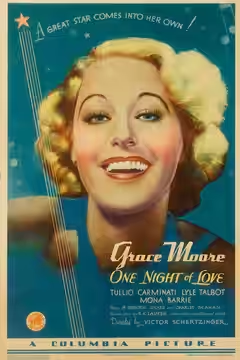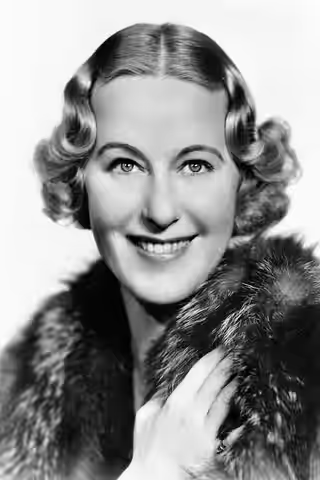
Grace Moore was a Metropolitan Opera soprano who made films so that people who would never buy an opera ticket could hear one. The acting is brisk and limited; the singing is the real thing, when the microphones of the day could hold it.
Fi1m perspective
Halfway through One Night of Love (1934), Tullio Carminati's Giulio Monteverdi makes Mary Barrett run scales while he butters his toast. Grace Moore, as Mary, looks properly annoyed. Then she opens her mouth and the picture changes shape around her. That is her habit and, for most of her screen career, her whole method: the plot marks time until she sings, and when she sings she is not pretending. Other actors of the period mimed to a dubbed soprano or held a note for the length of a shot. Moore had sung Mimì at the Metropolitan Opera in 1928 and stayed there for sixteen seasons, and the camera simply records what she could do.
The films came second and she never quite disguised it. She had started in Broadway musicals in the early 1920s before training in Europe for opera, and MGM signed her in 1930 for A Lady's Morals, in which she played the historical soprano Jenny Lind, and New Moon. Neither made her a film star. Columbia did, four years later, when Harry Cohn put her in Victor Schertzinger's One Night of Love, a backstage romance built to carry her voice and not much else. Five more Columbia pictures followed through 1939, among them The King Steps Out (1936), directed of all people by Josef von Sternberg, and Louise (1939), a film of the Charpentier opera in the part widely counted as her greatest on stage.
What works is the voice, and what she does when she is not using it is kept sensibly small. As an actress she is brisk and unfussy and does not do much beyond stubborn and hopeful, which is what the parts ask. Carminati gets the best out of her by playing the tyrant teacher half as a joke on himself, so that she has something to push against. What does not work, in 1934 at least, is the recording. In the café, singing at conversational volume, she sounds like a person and we found ourselves leaning towards the screen. On the opera stage her top notes pinch into a whistle through tin and the orchestra flattens behind her, and we winced on her behalf, because it fails her at exactly the moments the film has been saving up for.
The later Columbia films, When You're in Love (1937) and I'll Take Romance (1937) among them, had a more mixed reception than the breakthrough. We have not reviewed them and will not judge what we have not sat through. The studio's plan, to put opera excerpts in front of a cinema audience that would not otherwise hear them, does not appear to have changed.
Start with One Night of Love and do not expect an actress. Expect a soprano with a plot round her, and listen hardest in the quiet scenes, where the microphones could keep up.
Biography
Grace Moore was an American operatic soprano and actress. Born Mary Willie Grace Moore on 5 December 1898 in Slabtown, Tennessee, she made her Metropolitan Opera debut in 1928 as Mimi in La Bohème and appeared in several films, including A Lady's Morals (1930) and New Moon (1930).
She played the role of Mary Barrett in the 1934 musical film One Night of Love, for which she received an Academy Award nomination for Best Actress. Her films helped bring opera to wider audiences. Moore was married to the Spanish actor Valentin Parera and published an autobiography in 1944. She died in a plane crash near Copenhagen on 26 January 1947.