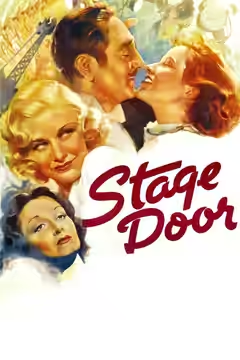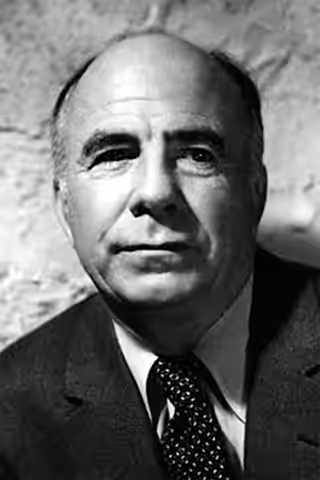
Gregory La Cava made comedies by letting people talk over one another, often without a finished script, and it produced some of the quickest films of the 1930s. Stage Door is the one to see; the career around it is patchier than it deserved.
Fi1m perspective
The dining-room scenes in Stage Door (1937) run six or seven conversations at once. William Hamilton cuts them so you catch the end of a joke at one end of the table while another is being set up at the other, and Robert De Grasse shoots the house deep, so there is nearly always a woman in the background about to interrupt. La Cava let his actresses improvise, and you can hear it. That was how he worked: often with no fixed script, dictating dialogue on the set or rewriting each day to fit whoever was in front of him, sometimes building scenes out of conversations he had overheard.
He came to it sideways. He started as a cartoonist and animator, ran Hearst's International Film Service in 1917 and 1918 and directed more than a hundred animated shorts before moving to two-reel comedies in the early 1920s and features from the middle of that decade, including So's Your Old Man (1926) with W.C. Fields. Sound suited him better than silence did. The 1930s brought Gabriel Over the White House (1933), a political fantasy nothing like his comedies, She Married Her Boss (1935) with Claudette Colbert, My Man Godfrey (1936) and then Stage Door. After the late 1930s the films thinned out badly, and he died in 1952.
What the method bought him was people who sound like people. My Man Godfrey is a screwball comedy that keeps noticing the Depression going on outside the frame. His films tend to put a woman at the centre and let her carry the moral weight, and he worked repeatedly with the same hands: Ginger Rogers three times, the producer Pandro S. Berman three times, Fields twice. We laughed through the first hour of Stage Door and were not ready for how much the second half hurt, and the reason is that hour: La Cava had spent it teaching us to like these women by letting them be unkind to each other, so when the talk stops, we notice.
What the method cost was somebody else's money. Rewriting daily and shooting without a finished script meant overruns and disorder, and Stage Door was one of the films that caused them. He did not apologise for it. Of the stars he was warned about, he said that "so-called temperament is just a higher form of intelligence," which is the sentence of a man who preferred difficult actors to tidy schedules. Start with Stage Door, then My Man Godfrey, and be aware that a director who needed the right actors around him made fewer good films than he should have once they were gone.
Biography
Gregory La Cava was an American film director. Born in Towanda, Pennsylvania, he began his career as a cartoonist and animator before moving into live-action shorts in the early 1920s and directing features from 1924.
He is best known for his 1930s comedies, including My Man Godfrey (1936) and Stage Door (1937). Both films earned him Academy Award nominations for Best Director. La Cava worked across several major studios and directed more than twenty features during the sound era.