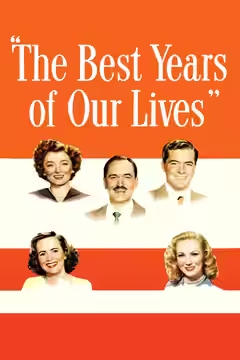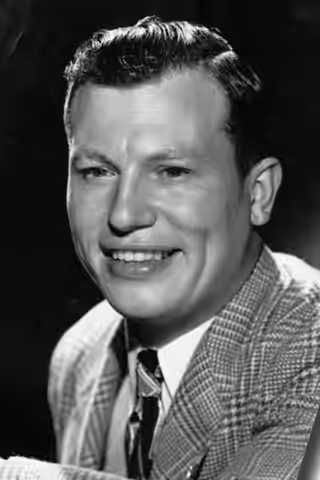
Harold Russell was not an actor and never became one, and his one great part depends on it. Homer Parrish has learned his hooks and has not yet learned the people, and William Wyler's camera simply watches him try.
Fi1m perspective
Wilma runs across the lawn from next door and Homer does not know where to put his arms. That is the whole of what Harold Russell does in The Best Years of Our Lives (1946), and it is a great deal. He stands a little too upright, hooks at his sides, face open and waiting for instructions that do not come. Nothing is being acted. He is a sailor home from the war who has been taught to manage a prosthetic and has not been taught what to do when his mother sees it for the first time.
He came to the film sideways. Russell enlisted in the US Army after Pearl Harbor and lost both hands in a TNT accident in 1944 while training paratroopers. He appeared in an Army training film, Diary of a Sergeant (1945), and William Wyler saw it and cast him as Homer, rewriting the part to fit the man in front of him rather than the other way round. Afterwards Russell went to business school in Boston and spent most of his life working for veterans and disabled people. There were a few later screen parts, Inside Moves (1980) as Wings and Dogtown (1997) as Blessed William among them, but no career in the usual sense, and it is sometimes counted against him that he did not pursue one. We think that gets it backwards.
What makes Homer work is exactly what a trained actor would have tried to fix. A professional would have shown us a man coping, with all the small business that coping involves. Russell shows us a man who is coping, which from the outside looks like almost nothing: stillness, a stiff politeness, an effort not to be watched. Wyler builds the scenes so that the people around him do the moving. Minna Gombell, as his mother, sees the hooks on her own front step and makes one sound, and the camera stays. Cathy O'Donnell's Wilma runs, and Homer receives her as if he had been handed something fragile with no hands to hold it. The homecoming got to us far more than we were ready for, and it was not Russell's face that did it but that sound and Wyler's refusal to cut away from what it does to the boy standing there.
His limits are real and the film knows them. When Homer has to carry a line rather than a moment, the flatness shows, and Wyler gives him short sentences and lets other people talk. Put Russell in a part that needed him to persuade rather than to be, and we doubt it would have held. It did not need to. Wyler wanted the thing that could not be faked, and he found the one man who could not fake it.
One film, then, and it is enough. See it for Homer, and do not go looking for the rest; Russell had the good sense to go and do something else.
Biography
Harold Russell was a Canadian-American actor and World War II veteran. He played Homer Parrish, a sailor who had lost both hands, in William Wyler's The Best Years of Our Lives (1946).
Russell lost both hands in a training accident while serving in the US Army. He was cast after appearing in the Army documentary Diary of a Sergeant. For the role he received the Academy Award for Best Supporting Actor and an honorary Oscar for bringing aid and comfort to disabled veterans, making him the only performer to win two Academy Awards for the same performance. He was the first non-professional actor to win an Oscar for acting.
Russell later appeared in the films Inside Moves (1980) and Dogtown (1997), and in television episodes. In 1992 he sold his Best Supporting Actor Oscar at auction.