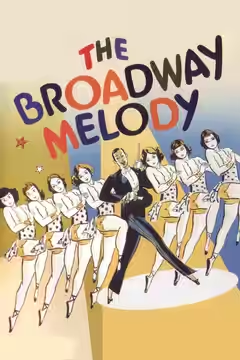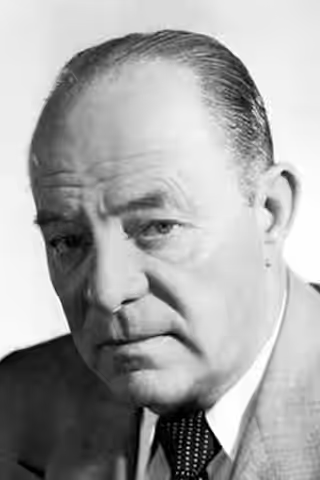
Harry Beaumont was a studio man who could get actors talking when the camera could barely move, and who finished his pictures on time. His one famous film, The Broadway Melody (1929), shows both the skill and its limits.
Fi1m perspective
Two sisters in a hotel room, one bed, one man between them. That is the stretch of The Broadway Melody (1929) that still plays, and it is the part Harry Beaumont knew how to direct. He puts the camera where it can see both women, gets them talking and lets Bessie Love do the rest. Nobody sings. It is the best half hour in the first all-talking musical, and the singing has nothing to do with it.
Beaumont came up the long way. He acted in travelling stock companies, then on the New York stage, and joined Edison in 1912 as an actor and writer before he began directing in 1915. Through the 1920s he moved between studios and settled at MGM, where he made silents built around stars: Beau Brummel (1924) for John Barrymore, and Our Dancing Daughters (1928), the flapper picture that helped launch Joan Crawford. We have not reviewed either, but they tell you what the studio thought he was for. He was the man you gave a star to.
Then sound arrived and MGM gave him its first all-talking musical. The technical problem was real: early sound meant the camera had to sit inside a soundproof booth, and the production of The Broadway Melody found a way to make the booth mobile. What reaches the screen is still a camera that barely stirs. Beaumont directs the talk well and the spectacle hardly at all. When the stage numbers come on, they arrive, sit there and leave. We were bored for a good half hour in the middle, and we were bored because a chorus line filmed from a fixed seat in the stalls is not a film, it is a seat in the stalls. Then the picture went back upstairs to the sisters and we sat forward again.
That was the peak. Lord Byron of Broadway (1930) followed, another musical, and after that his work shifted to lower-budget features and second features, mostly at MGM, until Alias a Gentleman in 1948. His reputation inside the studio was for efficiency, for finishing on time and without fuss, and that is not a small thing in a factory. It is not, on its own, a reason to seek out his films.
Watch The Broadway Melody for Bessie Love and the hotel room, and treat the numbers as an interval. Of the rest, the Barrymore and Crawford silents are the ones to be curious about. The twenty years after 1929 are for completists.
Biography
Harry Beaumont (1888–1966) was an American film director, actor and screenwriter. He began working in the industry as an actor with Edison studios around 1912 before directing from 1915, later working for studios including Fox, Goldwyn, Warner Brothers and Metro-Goldwyn-Mayer.
Beaumont directed several notable silent-era films, including Beau Brummel (1924) with John Barrymore and Our Dancing Daughters (1928) starring Joan Crawford. He directed MGM's first sound musical, The Broadway Melody (1929), which won the Academy Award for Best Picture; Beaumont received a nomination for Best Director.
He was married to actress Hazel Daly, with whom he had twin daughters born in 1922.