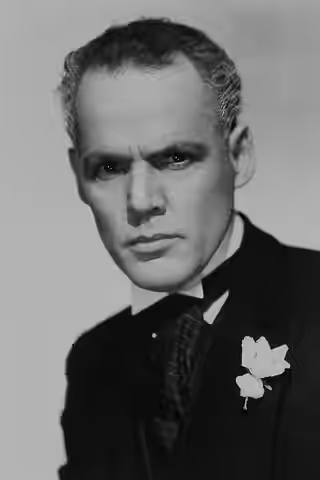
A stage actor who never entirely left the stage, Henry Hull brought a plummy voice and a theatrical manner to thirty years of doctors, editors and grumbling men with money. In small doses, which is how Hollywood mostly served him, it works.
Fi1m perspective
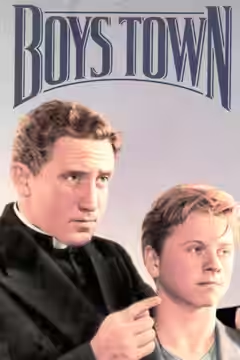
In Boys Town (1938) Father Flanagan needs money and goes to Dave Morris, a pawnbroker, and Henry Hull complains about every dollar before handing it over. He does it more than once, and it is the film's best running joke. We laughed each time the wallet came out, because Hull plays the grievance at full volume and the generosity as something he would rather nobody noticed. It is a small part in a film that admires its subject too much to doubt it, and Hull is one of the few people in it allowed to be difficult.
He came to films late. He had been on Broadway since 1911, after studying engineering, and in 1933 he created Jeeter Lester in Tobacco Road, which ran until 1941. Hollywood took him from the mid-1930s, but he stayed a free-lancer so that he could go back to the theatre, and he made 74 films before stopping in 1966, with television westerns and dramas after that. His one screen lead of note was Dr Wilfred Glendon in Werewolf of London (1935), the first werewolf feature. After that the studios mostly used him as the man in the good suit: 'Doc' Banton in High Sierra (1941), Charles J. Rittenhouse in Hitchcock's Lifeboat (1944), Henry Cameron, the mentor architect, in The Fountainhead (1949).
What he brought was the voice, rich and cultured and plummy, and the stagecraft that came with it: the pause before the line, the hand that finishes the sentence. It suited authority and it suited eccentricity, and he was cast for both, as doctors, editors and industrialists who could be relied on to fill a scene without being asked twice. It did not always suit the camera. The manner was formed in the theatre of the early 1900s, and it can come across as declamatory and dated, in The Return of Frank James (1940) among others. A fellow player on Lifeboat summed him up as a slice of ham, and the phrase has stuck.
We would put it more kindly. Ham is what stage technique gets called when there is a camera in the way, and Hull never pretended there was not one. The pawnbroker in Boys Town is the size of part that suits him: long enough to establish the manner, not long enough for it to wear. If Dave Morris is to your taste, the doctor, the ship's passenger and the architect are waiting in the same voice, and none of them will be doing anything quietly.
Biography
Henry Watterson Hull (3 October 1890 – 8 March 1977) was an American character actor. He appeared in 74 films between 1917 and 1966, frequently in supporting roles, and had a substantial stage career.
Hull was born in Louisville, Kentucky. He studied engineering before turning to acting and made his Broadway debut in 1911. He originated the role of Jeeter Lester in the long-running Broadway production of Tobacco Road (1933).
His film credits include the lead role of Dr Wilfred Glendon in Werewolf of London (1935), Dave Morris in Boys Town (1938), Charles Rittenhouse in Lifeboat (1944), Doc Banton in High Sierra (1941), and Henry Cameron in The Fountainhead (1949). He also appeared in television series including Bonanza.