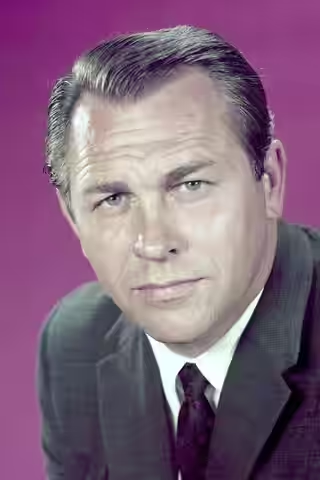
Howard Keel was a voice with a man attached: a big, easy bass-baritone that filled MGM's Technicolor musicals and a screen presence that never doubted its welcome. Ask him to sing and he is superb. Ask him to brood and the film waits.
Fi1m perspective
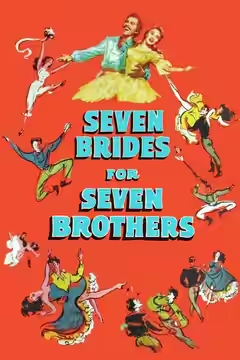
Howard Keel comes down the mountain in Seven Brides for Seven Brothers (1954) singing 'Bless Yore Beautiful Hide' and running an eye over the women of the town as if they were heifers at market. It is the Keel entrance in one stroke: the voice first, arriving before the man has said a word of dialogue, and the man behind it entirely pleased with himself. He does not wink at us. Adam Pontipee means every word, and Keel plays the boorishness straight, which is why the joke works and why Jane Powell's Milly has something to push against.
The voice was the career. He came up on Broadway in the mid-1940s, understudying and then replacing leads in Carousel and Oklahoma, took the latter to London in 1947, and signed with MGM, where from Annie Get Your Gun (1950) to Kismet (1955) he was the studio's leading man for Technicolor musicals: Frank Butler, Gaylord Ravenal in Show Boat (1951), Fred Graham and Petruchio in Kiss Me Kate (1953), Wild Bill Hickok on loan to Warner Bros. for Calamity Jane (1953). Three times he was paired with Kathryn Grayson, once with Powell, and once, on Seven Brides, with Stanley Donen, who got the best film out of him. When the studio musical faded he went into Westerns and action pictures, and a later generation knows him not from any of this but as Clayton Farlow in Dallas (1981–1991).
What he could do: sing, in a bass-baritone with real size and no strain, and stand in front of it with the shoulders of a man who has never been turned away from anywhere. In Seven Brides the scenes are his whenever he opens his mouth, and the studio's painted backdrops stop mattering for as long as the song lasts. We laughed at that entrance and felt slightly guilty about it, because the number is a man's shopping list for a wife, and Keel sings it so well that the objection arrives a beat late.
What he could not do is the quieter part of the job. When Adam goes off to sulk in a trapper's hut, the film stalls, and the fault is the actor's as much as the script's: Keel is a large warm voice attached to a limited player, and sulking asks for something inside that he never carried. He knew it, or near enough. "As long as I can sing halfway decent, I'd rather sing than act," he said, and the films bear him out. Between numbers he waits, pleasantly, for the next one.
Go to Seven Brides first, for the entrance and for what Powell does with him, and to the Grayson pictures after if the voice is what you came for. Do not go looking for the man behind it. There was a singer there, a good one, and he was honest enough to say so.
Biography
Howard Keel was an American actor and singer. Born Harold Clifford Keel on 13 April 1919 in Gillespie, Illinois, he died on 7 November 2004 in Palm Desert, California.
He appeared in a number of MGM film musicals in the 1950s, including Annie Get Your Gun (1950) as Frank Butler, Show Boat (1951), Calamity Jane (1953) as Wild Bill Hickok, Kiss Me Kate (1953) as Fred Graham / Petruchio, and Seven Brides for Seven Brothers (1954) as Adam Pontipee. He later played Clayton Farlow in the television series Dallas from 1981 to 1991 and appeared in The Day of the Triffids (1963).
Keel had a background in stage musicals before his film career and continued performing on stage and in television into later decades.