Film review

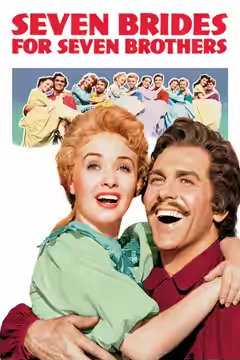
Seven Brides for Seven Brothers

1954 · Directed by Stanley Donen · 1h 43m · MPA G

In a sentenceSix filthy men learn to wash behind their ears and then take a Roman history lesson far too literally

ComedyDramaWestern

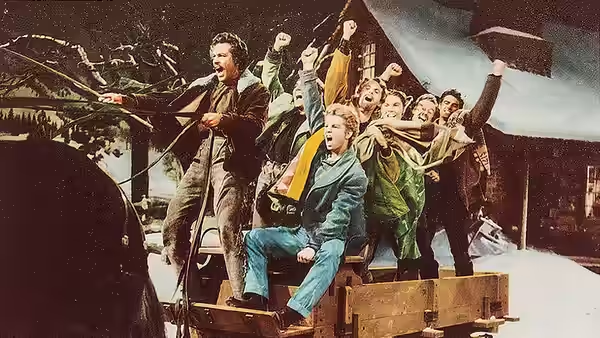
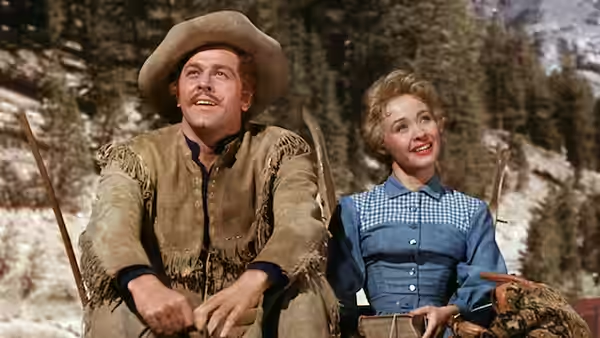
Oregon, 1850. Adam Pontipee (Howard Keel), a farmer from high in the mountains, rides into town for supplies and announces he means to leave with a wife by nightfall. He finds Milly (Jane Powell) cooking and serving at the boarding house, proposes over the stew and marries her the same afternoon. Only on the wagon ride home does she learn that he has six brothers, among them the youngest, Gideon (Russ Tamblyn), and the largest, Benjamin (Jeff Richards), and that the cabin she has married into has not been cleaned in years. Milly sets about washing, feeding and drilling them in manners, then takes the lot to a barn raising in town, where the brothers meet the local girls, Dorcas (Julie Newmar) and Ruth (Ruta Lee) among them, and the young men already courting them.

Fi1m review

Stanley Donen’s frontier musical has one of the best-danced quarter hours in any MGM picture and a plot that treats a crime as a courtship. Jane Powell holds the two together, just, and the barn raising alone is worth the evening.

Stanley Donen made this two years after Singin’ in the Rain. That film was about show people who knew exactly what they were doing. This one, from a Stephen Vincent Benét story with a screenplay by Dorothy Kingsley, Frances Goodrich and Albert Hackett, is about seven Oregon farmers who do not know how to use a fork, and what happens when the eldest brings home a wife. It has some of the best dancing MGM put on film and a plot that treats a serious crime as a courting ritual. The film half-knows this, and the half is Jane Powell.

Howard Keel’s Adam comes down from the mountain singing ‘Bless Yore Beautiful Hide’ and looking over the women of the town as if they were heifers at market. Keel has a big, easy baritone and plays the boorishness straight, and that is right: the joke is on him, and Powell’s Milly is there to make sure. She marries him inside an afternoon, discovers six unwashed brothers waiting at the cabin, and does not cry. Powell is small and brisk and sings without a wobble, and she plays Milly as a woman who has taken a bad deal and decided to run it. The kitchen number in which she teaches the brothers to bow and hold a partner, ‘Goin’ Courtin’’, is a small pleasure done exactly right.

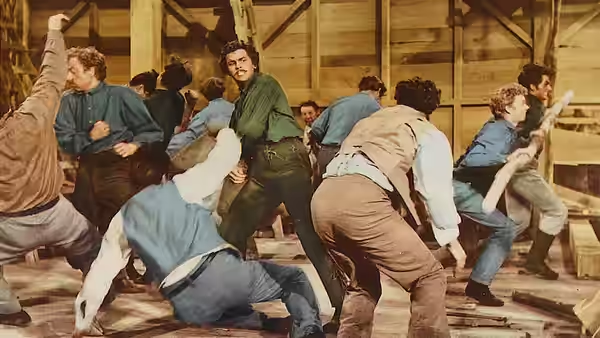
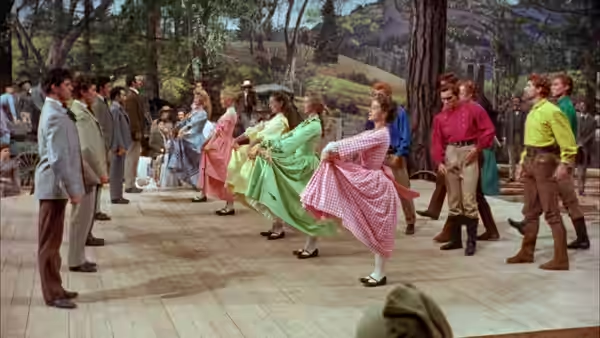
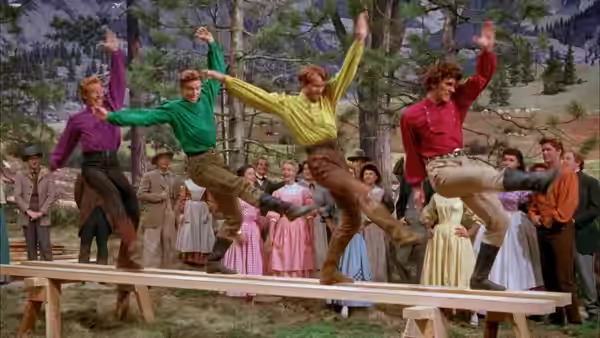
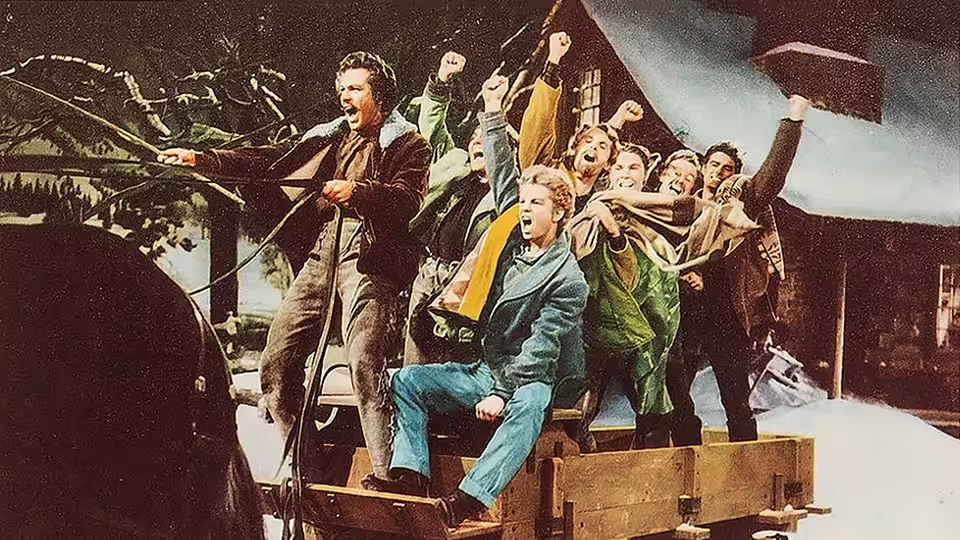
Then the barn raising, and for a quarter of an hour the film is as good as this kind of thing gets. Michael Kidd’s choreography sends the brothers and the town boys across planks, over sawhorses and up half-built walls, and George J. Folsey’s wide frame holds all of it; Ralph E. Winters seems to cut only when someone is in the air. Walter Plunkett puts each brother in a shirt of a different colour and each girl in a dress that answers it, so that fourteen people can cross a crowded frame and you always know which pair you are watching. Russ Tamblyn does back-flips across the planks, Tommy Rall and Matt Mattox trade turns like a duel, and Jacques d’Amboise moves like the ballet dancer he is. We sat forward when it started and were still forward when the barn came down, and we would show it to anyone who thinks they do not like musicals.

Then the story does what its title promises. Adam tells his brothers the old tale of the Romans and the Sabine women, and they take it as instruction. We will not describe how, but we will say what we felt: we laughed at Tamblyn’s face, and then we stopped laughing, and the film, to its credit, stops too. Milly’s anger is written as anger, not as a wife’s scold, and the brothers are turfed out to the barn to think about what they have done. But the second half needs the girls to come round, and it hurries them there. Julie Newmar, Ruta Lee, Nancy Kilgas, Virginia Gibson and Norma Doggett are given a change of heart and almost nothing else to play, and their suitors from town are not even given that.

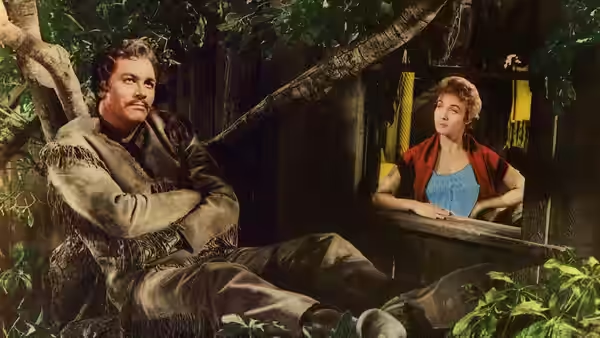
The winter stretch has one more number of real quality. ‘Lonesome Polecat’ is six men chopping and sawing in the snow, sung slow and low, the axe strokes falling on the beat, and it is the one point where the studio’s painted mountains look right rather than cheap. Gene de Paul’s tunes, with Johnny Mercer’s words, are sturdy throughout; the scoring, credited to Conrad Salinger and Adolph Deutsch alongside de Paul, keeps the orchestra out of the singers’ way. Between the songs, though, the cabin scenes sag. Adam goes off to sulk in a trapper’s hut, and Keel, a large warm voice attached to a limited actor, is not built for sulking.

Set against Singin’ in the Rain, this is a coarser, louder film, and it is honest about that. The tagline promises singing, dancing and romancing, and it has the first two in abundance. The third is where it is weakest, because Kingsley, Goodrich and Hackett never decide whether Adam’s stubbornness is a flaw to be cured or a virtue the film quietly admires, and the last reel splits the difference.

It runs 103 minutes and carries a U, and the certificate is fair. Nothing on the screen would trouble a child; it is the parents who may want a word afterwards about how one goes about getting a wife.

Critical consensus AI synthesised

67
Positive
6
Mixed
1
Negative
2

Most critics are warm towards it, and the praise lands almost entirely on the dancing. Michael Kidd’s athletic choreography, and the barn-raising sequence above all, is named again and again as the reason to watch, and more than one review credits Stanley Donen’s direction with serving it well. The Mercer and de Paul songs are liked, Howard Keel and Jane Powell are thought a good vocal match, and Powell’s timing draws particular notice.

The spread is wide. The reservations fall on the story rather than the staging: The New Yorker finds the hillbilly plot arch and contrived, and Time Out thinks the lead performance inexpressive and the score cosy. The sharpest dissent comes from HeyUGuys, troubled by the abduction and forced-marriage plot and its gender politics, though Collider reads the same material as a sly critique of patriarchal attitudes through its heroine. Admirers and detractors alike exempt the dances.

Slant Magazine
21 December 2011 · festival review
90*

The critic praises the film's explosive energy within the MGM musical canon and highlights Jane Powell's spunky conviction and sharp timing as central to its success. They note the movie's robust conviction, lightness of spirit, and thrilling expansion of dance parameters, while appreciating how it turns set-bound artifice into an advantage.

Read the full review →
The New York Times
25 July 1954 · A. H. Weiler
90*

The film has bounce, color, movement, a strong score and imaginative choreography that restore faith in the Hollywood musical. It follows conventions gracefully with charm and warmth drawn from its folk-tale source.

Read the full review →
Empire
21 March 2007 · Emma Cochrane
80*

The critic calls it an infectiously enjoyable and colourful musical with great songs, set pieces and solid performances. She singles out the energetic Barn Raising sequence and Michael Kidd’s athletic choreography as a standout.

Read the full review →
The Times
7 May 2005 · Laura Lee Davies
70*

The critic describes this digitally restored MGM musical as a feelgood matrimonial tale with pioneer spirit, where the bride takes charge amid the brothers' antics inspired by the Sabine women story. She praises the dance sequences and notes the insightful DVD extras including Donen's commentary.

Read the full review →
Variety
31 December 1953 · Variety Staff
70*

The critic calls it a happy, hand-clapping country musical with slick Broadway polish. Songs by Mercer and de Paul are lively, the barn-raising hoedown stands out, and leads Keel and Powell pair well vocally and otherwise.

Read the full review →
Time Out
1 February 2012 · SG
50*

The film is best appreciated as a showcase for its acrobatic dance sequences, whose choreography is well served by Donen's direction. The score feels cosy and the lead performance is rather inexpressive.

Read the full review →

Cast

Awards

Academy Awards, 1955

Nominated
Best Cinematography, Color
Nominated
Best Film Editing
Nominated
Best Picture
Nominated
Best Writing, Adapted Screenplay
Won
Best Original Musical Score

If you liked this, try…

Calamity Jane poster

Calamity Jane

1953 · Howard Keel again, opposite Doris Day, in a frontier musical with a sharper heroine.

West Side Story poster

West Side Story

1961 · Russ Tamblyn grown up, and gang dancing on real streets instead of painted mountains.

The Band Wagon poster

The Band Wagon

1953 · Michael Kidd choreographing Fred Astaire; the same athletic invention in city clothes.

The Young Girls of Rochefort poster

The Young Girls of Rochefort

1967 · Jacques Demy’s French answer to the MGM musical, with Gene Kelly passing through.

Fiddler on the Roof poster

Fiddler on the Roof

1971 · Another village where marriages are arranged and the daughters have other ideas.