Stanley Donen lets song and dance carry the story, and keeps the jokes clear. We recommend him most warmly for Singin' in the Rain, whose pleasure in performance survives a rather thin romance.
Fi1m perspective
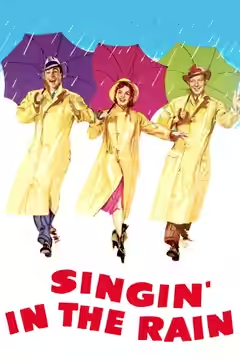
In Singin' in the Rain (1952), people who know how to perform discover that the new sound equipment has requirements of its own. Stanley Donen and co-director Gene Kelly make Hollywood's change of technology funny by keeping the difficulties practical. We laughed at the performers' loss of dignity, because the machinery is so unimpressed by their importance. This is the Donen we recommend without hesitation: generous with the singing and dancing, but willing to make the business of entertainment look ridiculous. No affection for old Hollywood is needed to recognise the trouble at work.
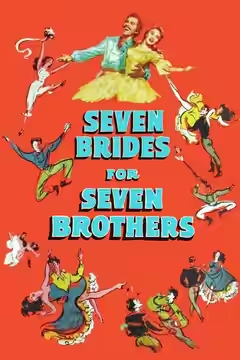
His first feature, On the Town (1949), co-directed with Kelly, had already taken the musical onto New York locations. Donen's use of locations and crane shots gave dance more freedom than a fixed view of a stage could offer. Seven Brides for Seven Brothers (1954) continued the musical work, with athletic choreography in CinemaScope. But the appeal of Singin' in the Rain also owes much to Betty Comden and Adolph Green's screenplay, which leaves room for the numbers without forgetting that these people are making films. The romance is slight; the comic timing gives us more than enough reason to stay.
From the late 1950s, Donen moved towards non-musical comedies and thrillers. Audrey Hepburn links the phases, appearing opposite Fred Astaire in the Paris-set Funny Face (1957) and Cary Grant in the romantic thriller Charade (1963). Two for the Road (1967) pairs her with Albert Finney and moves backwards and forwards through a marriage. These films give us a useful route beyond the work with Kelly, without requiring a dutiful march through everything Donen directed. Try Charade to see how he handles attraction and timing without relying on a song.
Kelly's prominence can obscure Donen's contribution to their early films; giving Donen his due should not mean forgetting that they were co-directors. The uneven reception of later work, including his last theatrical feature, Blame It on Rio (1984), is a reason not to recommend the whole shelf indiscriminately. Begin with Singin' in the Rain, and save the argument about who deserves the credit until after the dancing.
Biography
Stanley Donen was an American film director and choreographer. Born in Columbia, South Carolina, on 13 April 1924, he died in New York on 21 February 2019.
He began his career as a dancer on Broadway before moving to Hollywood, where he worked as a choreographer on films including Cover Girl (1944) and Anchors Aweigh (1945). He frequently collaborated with Gene Kelly, co-directing On the Town (1949) and Singin' in the Rain (1952).
Donen directed other notable musicals such as Seven Brides for Seven Brothers (1954), Funny Face (1957) and Royal Wedding (1951), as well as later films including Charade (1963) and Two for the Road (1967). He received an honorary Academy Award in 1998.