Film review

West Side Story

1961 · Directed by Jerome Robbins, Robert Wise · 2h 33m · MPA NR

In a sentenceThe finger-snapping is more frightening than the knives, and the lovers are the least interesting people on the block

CrimeDramaRomance

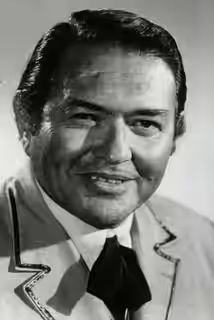
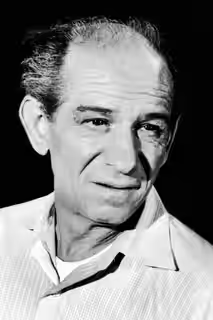
New York’s West Side, the late 1950s. Two street gangs claim the same few blocks of tenements and playgrounds: the Jets, led by Riff (Russ Tamblyn), and the Sharks, Puerto Rican newcomers led by Bernardo (George Chakiris). Riff wants a rumble to settle it, and he needs his old friend Tony (Richard Beymer), who has left the gang and taken a job sweeping up in Doc’s (Ned Glass) drugstore, to stand beside him at the dance in the gym. At the dance Tony sees Maria (Natalie Wood), Bernardo’s sister, newly arrived and working in a bridal shop with Bernardo’s girlfriend Anita (Rita Moreno). Lieutenant Schrank (Simon Oakland) and Officer Krupke (William Bramley) lean on both gangs while a war council meets at Doc’s to fix the terms.

Plays from YouTube when you press play; nothing loads from them until then.

Fi1m review

Robert Wise and Jerome Robbins’s film of the Bernstein musical still moves like nothing else of its period, and it goes slack whenever the dancing stops. See it for the Jets and the Sharks, and be patient with the lovers.

Robert Wise and Jerome Robbins open on Manhattan from directly above, the island laid out as a pattern of rooftops and car parks, and they hold it long enough that we started to wonder whether anyone was going to turn up. Then the camera drops into a playground and a boy in a blue T-shirt snaps his fingers. West Side Story is Romeo and Juliet moved to the West Side tenements of late 1950s New York, with the Jets and the Sharks in place of the Montagues and Capulets and Robbins’s choreography in place of the swordplay. It is a strange idea, and for about half its 153 minutes it works completely.

Here is the verdict for the sofa. Whenever the gangs are on screen, the film is alive from the soles of its feet up. Whenever Tony and Maria are alone together, it sits down and waits politely for the next number. That is a real flaw, and it does not stop us recommending it.

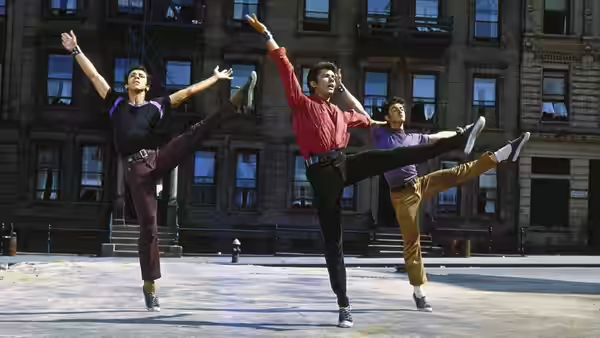
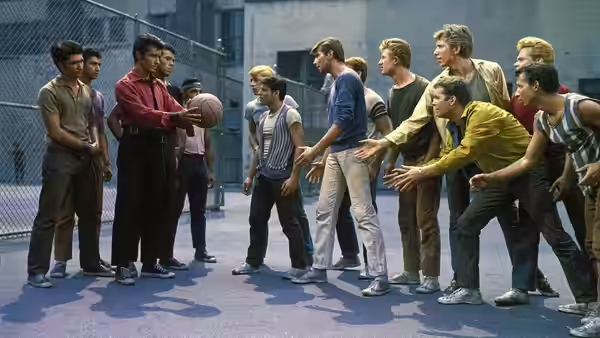
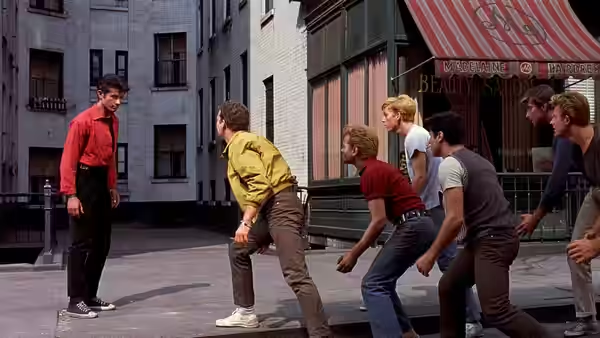
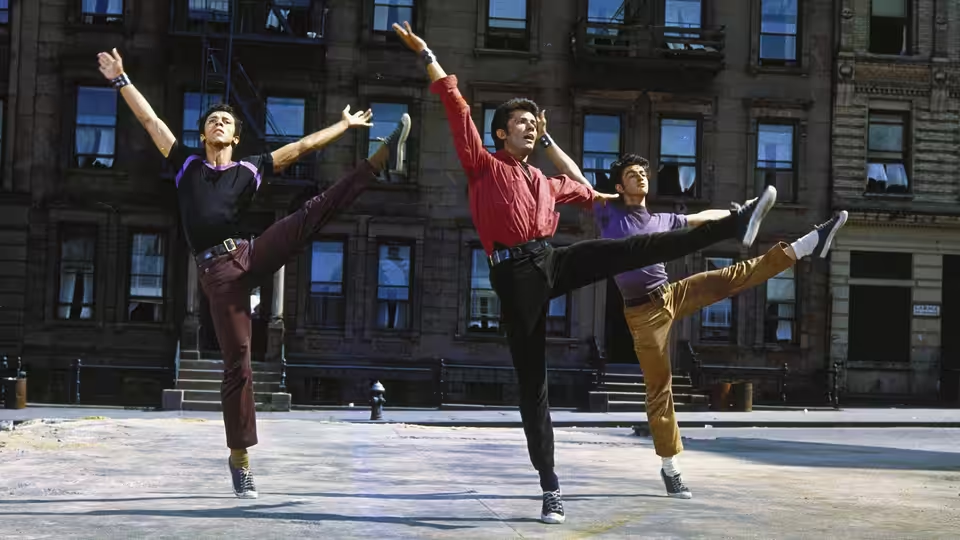
The Prologue is the reason it lasts. The Jets walk their street in a loose line, Daniel L. Fapp keeps the camera at hip height so the kerb and the brick slide past behind them, and then, with no warning, the walk becomes a leap. We have seen it many times and it still raises the hair on our arms, because Robbins has found a way to make dancing look like the thing these boys would do anyway if they had the space. Leonard Bernstein’s brass jabs rather than swells under them, and the three-note whistle the gangs use runs through the whole score like a threat. Boris Leven gives them real streets here and, for much of the rest, tilted painted tenements with fire escapes stacked like shelves. Irene Sharaff dresses the Jets in faded blue and mustard and the Sharks in purple, red and black, so a wide shot tells you who owns the ground before anyone speaks.

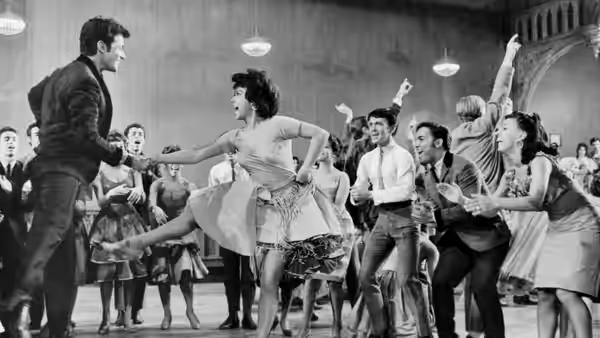
America, on a rooftop, is the number people remember and they are right. Rita Moreno’s Anita argues for New York and George Chakiris’s Bernardo argues against it, and the argument is conducted in skirts Sharaff has built to stand away from the body on the turn. Moreno is the best thing in the film: funny, quick, and later moving without changing key. The dance at the gym is nearly as good, the two gangs performing at each other across a floor until Thomas Stanford’s cutting quickens and the crowd blurs and there are two faces left in focus. It is the one stretch where the romance works, and Beymer and Wood do not say a word in it.

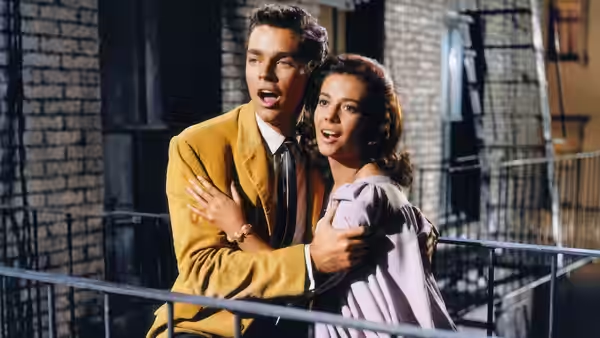
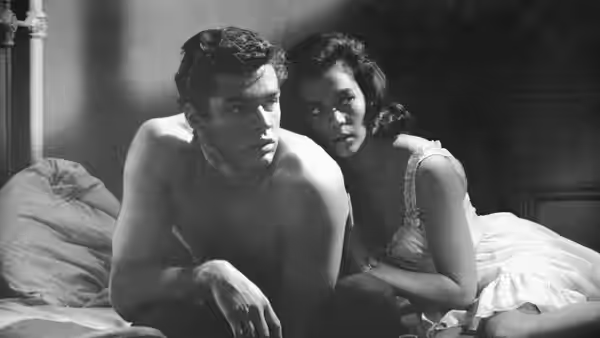
The trouble starts when they do. Ernest Lehman’s screenplay gives Richard Beymer a former gang leader who has grown out of the life, and Beymer plays the growing out as blankness. Beside Russ Tamblyn’s Riff, all coiled shoulders and grin, he barely registers, and the fire escape scene that stands in for the balcony is prettily lit and does not catch. Natalie Wood is warmer and sharper, but her singing is dubbed, as most critics have noted, and the voice that comes out is not quite the woman we have been watching. In the lovers’ scenes we found ourselves admiring the lighting and working out how long until the Jets came back. The dialogue between numbers is where the film’s age shows. Simon Oakland’s Lieutenant Schrank, a sour and openly bigoted cop, is the one adult who feels like a person; Ned Glass’s Doc is there to be disappointed in everybody, and the lines about what the city does to its young are delivered as speeches.

Most critics rate it a little higher than we do, and the disagreement is about the middle. They forgive the lovers because the dancing around them is so good. We are not sure a film of two and a half hours gets to coast on its best forty minutes, though this one comes closer than most. Cool, in a garage, with Tucker Smith’s Ice trying to hold a roomful of boys down to a snap and a hiss, tells you more about what is going on inside these kids than any line Lehman gave them.

The second half, which we will not describe, is slower and darker than the first, and the PG certificate is honest about the knives. Watch it on the biggest screen you own with the sound turned up, and give the lovers the benefit of the doubt. The boys on the fire escapes are why you came.

Critical consensus AI synthesised

82
Positive
12
Mixed
2
Negative
0

Most critics are in agreement: twelve of the fourteen notices are positive and none is negative. The praise gathers around Jerome Robbins’s choreography, with the Cool and America numbers picked out, and around the Bernstein and Sondheim songs. Reviewers also credit Robert Wise’s direction, Daniel L. Fapp’s photography and the colour of the costumes, and single out Natalie Wood, Rita Moreno and George Chakiris among the cast.

The reservations concern what happens between the dance numbers. Several critics find the dialogue scenes flat and the central romance thin, and a few note the dubbed vocals and casting choices as compromises of their era. The two mixed notices are both recent: Slant finds the leads uneven and the politics heavy-handed, and The AV Club thinks much of it has dated badly while still calling the dancing thrilling. The spread runs from a low of fifty to several top marks, but the middle is firmly admiring.

Radio Times
★★★★★ · Tony Sloman
100

The critic hails the electrifying and moving version of the Bernstein/Sondheim musical, an update of Romeo and Juliet set in late-1950s New York gangs, which earned ten Oscars plus a special award for Jerome Robbins’s choreography. Performances by George Chakiris, Natalie Wood and Richard Beymer are praised, along with co-director Robert Wise’s experience with musicals.

Read the full review →
Los Angeles Times
18 October 1961 · Philip K. Scheuer
90*

Scheuer hails the film as restoring glory to Hollywood with its powerful impact, brilliant choreography, and tense drama on juvenile delinquency. He singles out the music, dance numbers, and performances by the gang members and leads like Wood and Moreno for praise.

Read the full review →
The Guardian
18 October 2021 · Peter Bradshaw
90*

The 1961 film remains a blinder that is formally electric, musically alive and emotionally pummelling, with bodies in motion used to shape and dictate the film’s own rhythm in a way never seen before. Its Saul Bass opening credits and Robbins’s choreography, especially in numbers like Cool and America, keep it agile, athletic and crisply modern even at 60.

Read the full review →
The Hollywood Reporter
18 October 2016 · James Powers
90*

The critic calls it a magnificent milestone in movie musicals that has never been bettered, with fluid tandem direction by Wise and Robbins creating a harmonious whole and standout performances, especially from Natalie Wood.

Read the full review →
The New York Times
22 October 1961 · Bosley Crowther
90*

Crowther calls the film a thrilling cinematic achievement that advances the sophistication of the musical genre through its vivid translation of the stage material. He highlights the strong performances, especially by Natalie Wood and Rita Moreno, and the superb dancing.

Read the full review →
Variety
13 September 1961 · Whitney Williams
90*

Williams describes the film as a beautifully mounted, impressive and violent musical that powerfully translates the Broadway hit with realism and spectacle. He praises the direction, choreography, score, and performances, especially the gang members' dancing and menace.

Read the full review →

Cast

Awards

Academy Awards, 1962

Nominated
Best Writing, Adapted Screenplay
Won
Best Art Direction, Color
Won
Best Cinematography, Color
Won
Best Costume Design, Color
Won
Best Director
Won
Best Film Editing
Won
Best Original Musical Score
Won
Best Picture
Won
Best Sound
Won
Best Supporting Actor
Won
Best Supporting Actress

If you liked this, try…

The Red Shoes poster92

The Red Shoes

1948 · Powell and Pressburger let a ballet carry the story; the dancing is the argument

Rebel Without a Cause poster84

Rebel Without a Cause

1955 · The same restless boys and worried adults, without the songs and with a knife fight

The Umbrellas of Cherbourg poster

The Umbrellas of Cherbourg

1964 · Demy sings every line and paints every wall; a love story that also goes wrong quietly

Romeo + Juliet poster82

Romeo + Juliet

1996 · Luhrmann’s guns-and-Hawaiian-shirts version of the same play, louder and just as doomed

In the Heights poster

In the Heights

2021 · Another New York block sung from the fire escapes, sunnier and less bloodstained