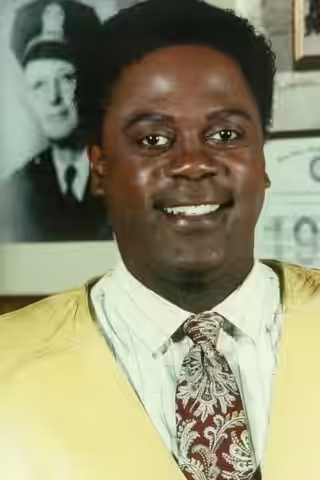
Howard Rollins played still, proud, buttoned-up men, and played them well enough that the films kept asking for nothing else. He was given one part that made his name, waited years for a second, and spent most of what followed on television.
Fi1m perspective
In A Soldier's Story (1984) Howard Rollins spends most of the film behind dark glasses. Captain Davenport arrives at an army base where nobody wants him, carrying a briefcase and a rank, and Rollins gives him a clipped Washington manner that leaves the white officers nothing to push against. He does not raise his voice. He does not need to. It is a performance built on holding still while everyone around him gives way, and it is the thing Rollins did better than most.
He came up through Baltimore theatre, went to New York in 1974 and worked his way through the miniseries King (1978) and Roots: The Next Generations (1979) before Miloš Forman cast him as Coalhouse Walker Jr., the pianist in Ragtime (1981). We have not reviewed it, so we will say only what has been said consistently since: that he played a man insulted past bearing with a pride that seemed to cost him something, and that people who saw it expected a great deal to follow. Very little did. Asked about the gap, he said: "The major issue is that I'm black. I guess the demographics on Madison Avenue don't say that someone like myself can carry a film..." Norman Jewison's A Soldier's Story was the film that finally arrived, and it took him straight to television, where from 1988 he played Virgil Tibbs opposite Carroll O'Connor in In the Heat of the Night for 121 episodes.
What worked was the restraint. Stage-trained, he understood that a man who will not show you what he feels is more interesting than one who will, and he could keep that going for two hours without it curdling into blankness. What did not work was what the films did with it. Jewison's picture wants Davenport as a witness rather than a man: a principle with a briefcase, there to watch Adolph Caesar, Denzel Washington and Art Evans do the feeling. Around the hour mark we caught ourselves wanting him to take the glasses off and say one thing the case did not require, and the film never let him, and that irritation stayed with us. It is the clearest sign we have that there was more behind the performance than the part asked for.
He died in 1996, at 46, with one film that everyone remembers, one that we recommend, and six years of a detective series in between. See A Soldier's Story for the ensemble, and watch Rollins in it as a study in how much an actor can do while being asked to do almost nothing.
Biography
Howard E. Rollins Jr. (1950–1996) was an American stage, film and television actor. Born in Baltimore, Maryland, he studied theatre at Towson State University before beginning his career in local theatre and moving to New York in the mid-1970s.
He gained recognition for his performance as Coalhouse Walker Jr. in the 1981 film Ragtime, which earned him an Academy Award nomination for Best Supporting Actor. Rollins played Captain Davenport in the 1984 film A Soldier's Story and portrayed Virgil Tibbs in the television series In the Heat of the Night from 1988 to 1995. He also appeared in television productions including the miniseries King (1978) and Roots: The Next Generations (1979).