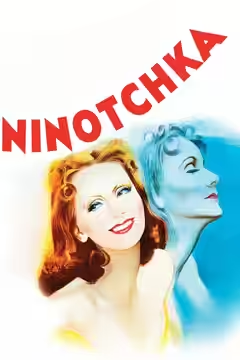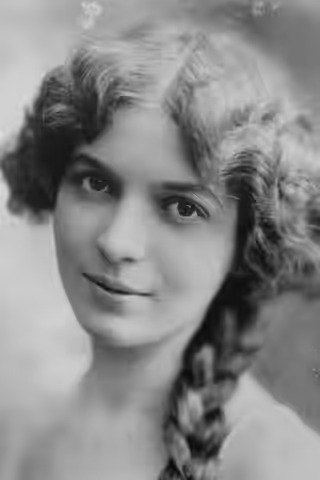
Ina Claire made nine films in twenty-eight years and needed only one to show what she did: high comedy played with the head, every intonation and gesture placed on purpose. Her Grand Duchess Swana in Ninotchka is the sharpest thing in a film full of sharp things.
Fi1m perspective
The Grand Duchess Swana in Ninotchka (1939) has lost her country and her jewels and is not going to lose her composure as well. Ina Claire plays her without ever raising her voice. Each insult arrives dressed as good manners, and the timing is so exact that the cruelty registers a beat after the smile. Her one long scene with Garbo has a bite the film's romance does not, and it is the moment the whole thing stops being charming and gets interesting. We found ourselves, for a minute or two, on the wrong woman's side, and a little ashamed of it. That is Claire's doing: she plays Swana's loss as a fact she has finished discussing, not a grievance she is still nursing, and dignity of that kind is hard to laugh at even when the script asks you to.
It was a stage manner, and she had spent more than thirty years building it. Claire started in vaudeville around 1907, doing imitations, went through the Ziegfeld Follies in 1915 and 1916, and from the late 1910s was a Broadway lead in comedies, with long runs in The Gold Diggers and The Last of Mrs. Cheyney (1925). She studied movement with a pupil of Delsarte and watched Eleonora Duse work. "You have to use your head in comedy," she said in 1928. "It was not merely a matter of intonation or of pitch, but of bodily movement." In the 1930s S. N. Behrman wrote three plays around her, beginning with Biography (1932), and her gift, by every account, was for making slight material sound better than it was and for puncturing pomposity without losing the joke's smaller notes.
The cinema got almost none of this. Nine films between 1915 and 1943, and she thought the medium belonged to the director and kept going back to the theatre, where it belonged to her. Ernst Lubitsch, who understood exactly what a raised eyebrow costs, is the one director who got a full performance out of her on film, and Adrian's gowns, which look worth more than the jewels Swana is fighting over, do half the characterisation before she opens her mouth. She said later that she regretted being typed in sophisticated comedy and not allowed the dramatic parts. Swana suggests she had a point; there is something underneath the wit that a braver producer might have used.
Her last stage appearance was in Eliot's The Confidential Clerk in 1954, and then she stopped. Nearly everything she was admired for happened in front of audiences who are now gone. What is left is one supporting part in a Paris hotel, and it is enough to make the loss plain. Watch Ninotchka for Garbo, as everyone does, and then watch it again for the woman she is talking to.
Biography
Ina Claire (born Ina Fagan) was an American stage and film actress. She began her career in vaudeville as a child and appeared in the Ziegfeld Follies of 1915 and 1916 before making her Broadway debut in 1911.
Claire became known for her roles in high comedies on Broadway, including plays by S. N. Behrman and others in the 1920s to 1940s. Her film appearances were fewer; she made her screen debut in 1915 and is best remembered for playing Grand Duchess Swana in the 1939 comedy Ninotchka.
She was married three times, including briefly to actor John Gilbert. Claire received a star on the Hollywood Walk of Fame and was inducted into the American Theater Hall of Fame. She died in San Francisco in 1985.