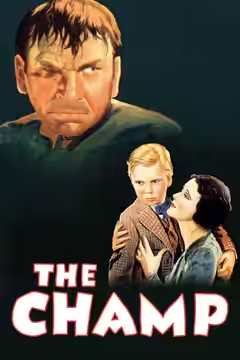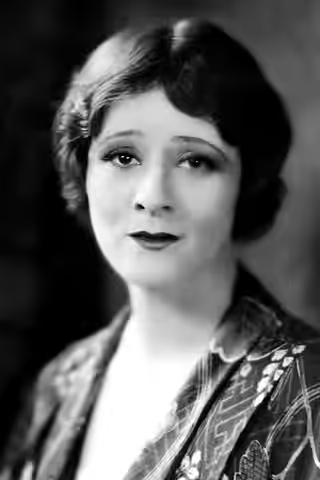
Irene Rich spent the silent years playing women who ran the house and the sound years playing women who understood everybody in it. On the evidence of The Champ, understanding is the less interesting job, and she was too good for it.
Fi1m perspective
In The Champ (1931), Irene Rich turns up rich, in a good coat, and wants her son back. King Vidor gives her Linda Carleton, the mother who left, and Rich plays her as a woman who has already forgiven everyone before the scene starts. She listens well. She never raises her voice. Set against Wallace Beery's sweat and Jackie Cooper's wet eyes, she is the calm at the edge of the frame, and the film leaves her there. We called her right and dull, and we stand by both words: there is no wrong note in the performance and nothing for the notes to push against.
That was not the job she started with. Rich came into pictures as an extra in 1918 and spent the 1920s in silent melodramas, cast as society women who knew exactly what they were worth, Mrs Erlynne in Lady Windermere's Fan (1925) among them. She made eight films with Will Rogers, usually as his wife, which is a long marriage by Hollywood standards. Then sound arrived, and with it the mothers. From 1933 to 1944 she hosted the radio anthology Dear John, and when she came back to film in the late 1930s and 1940s it was as Mrs Roth in The Mortal Storm (1940), Mrs Worth in Angel and the Badman (1947) and Mary O'Rourke, the frontier wife, in John Ford's Fort Apache (1948). Joan of Arc (1948) was among her last films; a Broadway run took her to 1950, and then she stopped.
We have not reviewed the silents, so we will not pretend to judge them, but the pattern in the record is hard to miss. The parts got smaller and kinder as the decades went on, and the qualities that had made her a lead, poise and a certain resourcefulness, were the ones a Hollywood mother of the period was not allowed to use. The trouble with The Champ is not Rich. It is that Frances Marion's story wants the mother to be reasonable, and a reasonable woman asking for her child back gives Beery nobody to fight. Hale Hamilton, playing her new husband as pure decency, has the same problem beside her. Two capable actors cancel each other out in a drawing room while the film's heart is in a Tijuana bar. We were moved by The Champ, more than a picture that stiff has any right to manage, and none of it happened while she was on screen.
That is the caveat, and it is also the recommendation. If you want to know what Rich could do, our one review is the wrong place to look, and the silents, by every account we have, are the right one. Watch The Champ for Cooper and Beery, note the woman in the good coat who never gets a scene of her own, and then go and find out what she did when the picture was hers.
Biography
Irene Rich was an American actress who worked in silent films and talkies. Credited as Linda Carleton in The Champ (1931), her other film roles include Mrs. Mary O'Rourke in Fort Apache (1948), Mrs. Worth in Angel and the Badman (1947), Mrs. Roth in The Mortal Storm (1940) and Catherine le Royer in Joan of Arc (1948). She also appeared in Lady Windermere's Fan (1925).
Rich worked with Will Rogers in eight films, including Water Water Everywhere (1920), The Strange Boarder (1920), Jes' Call Me Jim (1920), Boys Will Be Boys (1921) and The Ropin' Fool (1921). From the 1930s she hosted the radio anthology series Dear John (also known as The Irene Rich Show). She appeared on stage in Seven Keys to Baldpate (1935) and As the Girls Go (1948). She received stars on the Hollywood Walk of Fame for motion pictures and radio.