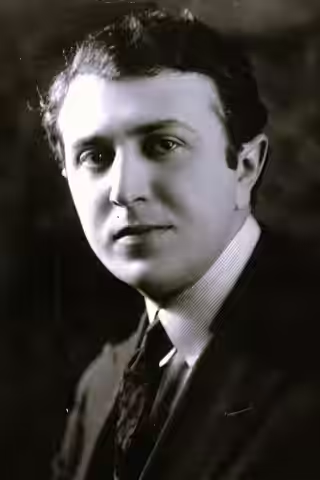
Irving Cummings is remembered for a microphone in a desert, on a film he did not start, then spent twenty years as Fox's dependable hand on Shirley Temple and Betty Grable musicals. The studio's style was his, which is neither insult nor compliment.
Fi1m perspective
The thing people remember from In Old Arizona (1928) is not a shot but a sound: hooves on hard ground, cattle, eggs in a pan. It was the first talkie to take its microphones outdoors, and Cummings came on to it after Raoul Walsh, so the two men share the credit and it is impossible to say whose desert we are hearing. We scored it 61. It is a landmark and a slog in about equal measure, and we admit that for long stretches we found ourselves listening rather than watching, which tells you where the achievement lies and where it does not.
He had been on the other side of the camera first. Cummings began on the stage around 1903, went into films as an actor in 1909 and was a popular leading man in silents into the early 1920s. He started directing shorts in 1921 and features in 1922, handled early sound Westerns and crime dramas, and then, from the mid-1930s, settled into what he would do for the rest of his working life: musicals at 20th Century-Fox. Curly Top (1935) with Shirley Temple, Down Argentine Way (1940) with Betty Grable, The Dolly Sisters (1945), with a co-directing credit on the Western Jesse James (1939) along the way. He retired in 1954.
What did he bring to them? The honest answer, and the one the reference books settle on, is that his style is hard to tell from the studio's. Fox in those years wanted big, bright Technicolor pictures built around a star, and Cummings gave it four with Temple and three with Grable, and Down Argentine Way is generally credited with helping to make Grable one. We have not reviewed those films and will not pretend to judge them at length. What we can say is that nobody has ever pointed at a Cummings musical and said that could only have been him, and that even the picture his name is attached to in the histories is half somebody else's.
There is a kind of director whose job is to get the star into the light, keep the numbers moving and bring the picture in on time, and it is not a small job or a dishonourable one. Cummings did it for twenty years, and the studio kept asking him back. If you want to know what he did, watch the person he was pointing the camera at. See In Old Arizona once, for the eggs; for the rest, the name to look for on the poster is the one above his.
Biography
Irving Cummings (born Irving Caminsky) was an American film director and actor. He began his career as a stage actor in New York before entering films as an actor around 1909 and directing from the early 1920s.
Cummings directed the early sound Western In Old Arizona (1928), for which he received an Academy Award nomination. He later specialised in musicals at 20th Century Fox, including Curly Top (1935) and Little Miss Broadway (1938). Other notable credits include Jesse James (1939, co-director) and The Cisco Kid (1931).