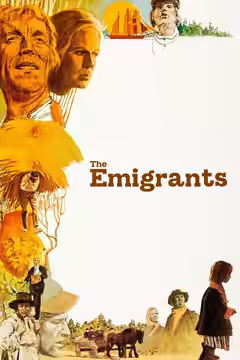
Jan Troell holds the camera himself and holds the shot longer than anyone else would, and at his best, in The Emigrants, the result is history you feel in your back and your stomach. We rate him highly, and we warn you to clear the evening.
Fi1m perspective
A man heaves a boulder out of a field. Most directors would show the strain, cut to the stone coming free and move on. Jan Troell keeps Max von Sydow in frame for the whole of the effort, and because Troell is holding that camera himself, the frame shifts a little as the man does. That is the habit that runs through everything he has made: he writes, directs, photographs and edits his own films, he operates the camera, he uses whatever light there is, and he holds the shot past the point where anyone else would have cut.
He came to it late and sideways. He was a primary-school teacher in Malmö making short films in the early 1960s, then shot films for Bo Widerberg, then made his first feature, Here's Your Life (1966), and followed it with Who Saw Him Die? (1968). The films that made his name were The Emigrants (1971) and The New Land (1972), adapted with his producer Bengt Forslund from Vilhelm Moberg's novels about Småland peasants leaving for Minnesota, and best watched as one work across two evenings. Hollywood followed, with Zandy's Bride (1974) and Hurricane (1979), and he went home. Since then he has made historical dramas, literary adaptations and documentaries in Sweden, among them Everlasting Moments (2008), about a family and a camera, and The Last Sentence (2012), about a journalist, and he kept working into his nineties.
What works is the patience. His people are farmers, servants and newspapermen; nobody makes a speech, and the ideas arrive through hands mending a plough and a child's face at the table. "I don't move the camera unnecessarily, usually," he has said. "As a photographer, composition is in my backbone, in a way." Von Sydow and Liv Ullmann, who worked with him repeatedly, understood what he wanted: in The Emigrants they carry three hours without once raising their voices. The hold of the emigrant ship in that film is the sequence we would show anyone who doubts him. He takes a hand-held camera and a few lamps down among the bunks and stays there, through lice and buckets and a storm heard through planks, until we found ourselves lying still with the passengers, wanting land as badly as they did.
What does not work is the same thing seen from the other side. The method makes long films, and The Emigrants runs 191 minutes before anyone sets foot on the land they crossed an ocean for. If you want incident, he will make you wait for it, and he will not apologise. We have not reviewed the two Hollywood films; the consensus is that they are not the place to start, and we see no reason to argue.
He is listed here as a cinematographer, which is fair, since he has said he feels like one. It is also the least of what he does on a set. Begin with The Emigrants, keep the following evening for The New Land, and do not look at the clock.
Biography
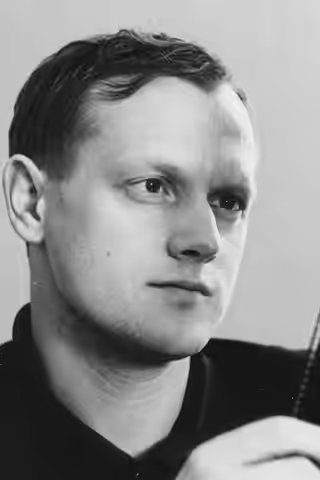
Jan Troell is a Swedish filmmaker, screenwriter and cinematographer. Born on 23 July 1931 in Limhamn, Malmö, he worked for several years as an elementary-school teacher before making short films in the 1960s.
His first feature, Here's Your Life (1966), was followed by Who Saw Him Die? (1968). Troell directed, co-wrote the screenplay, served as cinematographer and edited The Emigrants (1971) and its sequel The New Land (1972). Later films include Everlasting Moments (2008).
He won the Golden Bear at the Berlin International Film Festival for Who Saw Him Die?.