Film review

The Emigrants

1971 · Directed by Jan Troell · 3h 11m · MPA PG

In a sentenceThree hours of stone, porridge and seasickness, and not one speech about the American dream

DramaHistoryWestern

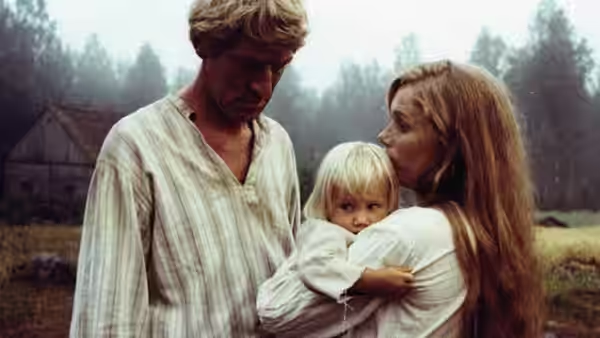
Småland, southern Sweden, in the middle of the nineteenth century. Karl Oskar (Max von Sydow) farms a small plot that is more stone than soil, and each harvest is worse than the last. His wife Kristina (Liv Ullmann) keeps the house and bears children they can barely feed. His younger brother Robert (Eddie Axberg) is hired out as a farmhand, is beaten by his master, and reads about America in a borrowed book. Kristina’s uncle Danjel (Allan Edwall) holds prayer meetings in his kitchen and is brought before the dean, Brusander (Gustaf Färingborg), for it, with Ulrika (Monica Zetterlund), the parish outcast, among his converts. After a drought and a death in the house, Karl Oskar decides they will sell up and sail for America. Kristina does not want to go.

Fi1m review

Jan Troell’s account of Swedish farmers leaving for America is slow, plain and exact, and by the time the ship reaches the far side of the Atlantic it had us. Von Sydow and Ullmann carry it without raising their voices.

Vilhelm Moberg wrote four novels about a group of Swedish peasants who leave Småland for Minnesota, and Jan Troell and his producer Bengt Forslund turned them into two films. The Emigrants is the first. It runs 191 minutes, and by the end the people we have been watching have only just set foot on the land they crossed an ocean for. The second film, The New Land, picks up from there. Anyone who wants the whole story should set aside two evenings.

It is worth the two evenings. This is one of the plainest films we know about leaving home, and one of the best, and the plainness is the reason. Nobody makes a speech about the promise of America. Karl Oskar (Max von Sydow) wants to go because his field is mostly rock and his children are hungry. His brother Robert (Eddie Axberg) wants to go because the farmer he works for hits him. Danjel (Allan Edwall) wants to go because the church has decided his kitchen prayer meetings are a crime. Troell takes an hour and a half over this because he wants us to feel the weight of what they are leaving before he shows us what leaving costs.

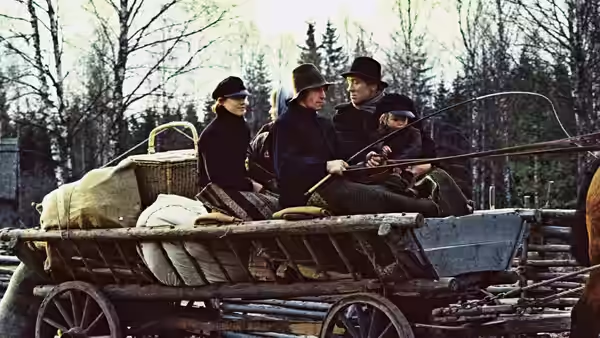
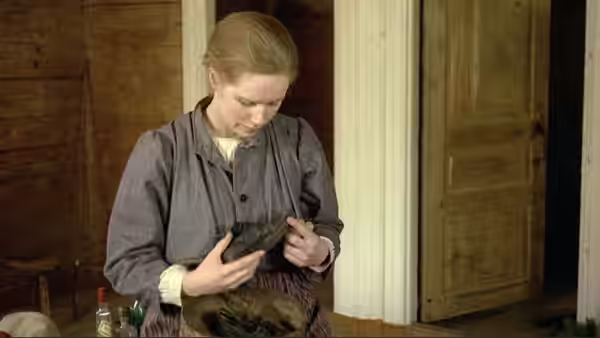
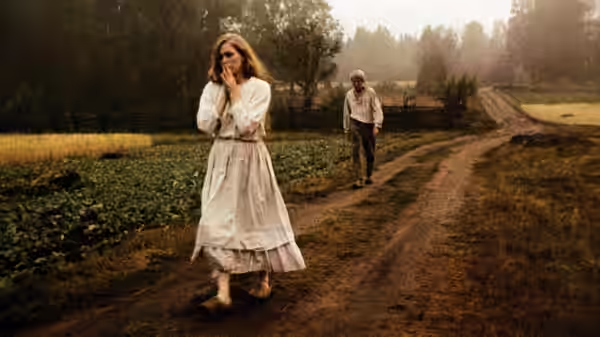
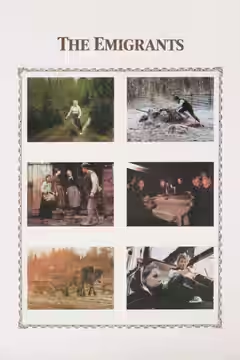
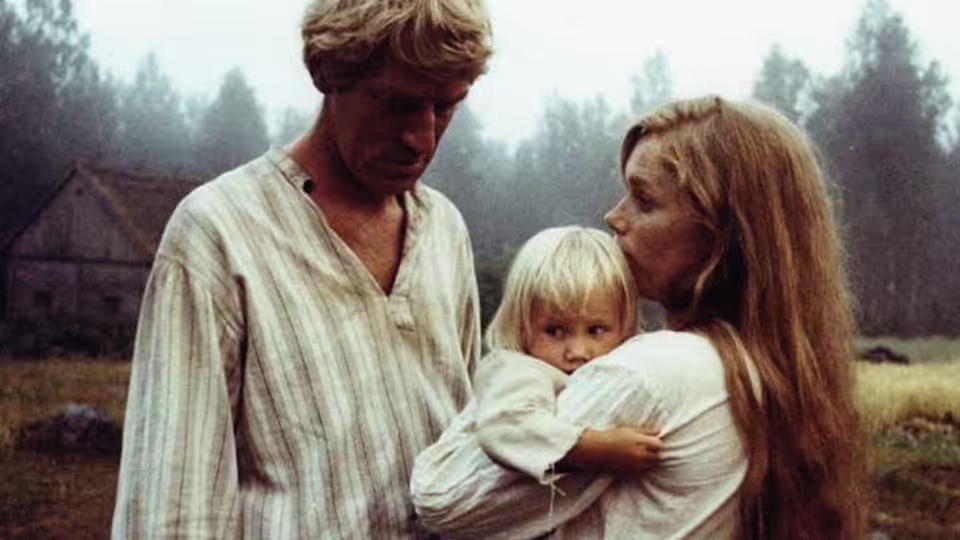
Troell directs, shoots and cuts the film himself, and you can tell. The camera is often hand-held and close, on hands mending a plough or a child’s face at the table, and he lets available light do the work: low sun through a doorway, a single lamp in a hold. He holds shots long after another editor would have cut, so when Karl Oskar heaves a boulder out of the ground we see the whole effort. Ulla-Britt Söderlund’s costumes are wool and linen the colour of the earth they come from, and they darken as the film goes on. Erik Nordgren’s music is used sparingly enough that when it arrives, thin and folk-like, it registers as an event.

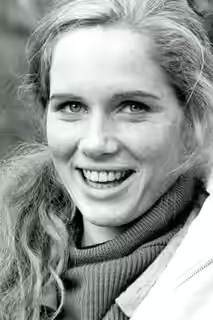
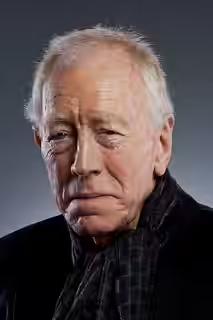
Von Sydow plays Karl Oskar as a man who has decided and will not discuss it again. He barely raises his voice in three hours. Liv Ullmann’s Kristina is the film’s conscience: she does not want to leave, says so, and goes anyway, and Ullmann shows the homesickness starting before the cart has left the yard. Axberg gives Robert a boy’s daydreaming and a boy’s bad luck. Monica Zetterlund, as Ulrika, the parish outcast who has found God and kept her tongue, is the one person on screen who seems to be enjoying herself. Edwall’s Danjel is gentle and slightly maddening, which is right.

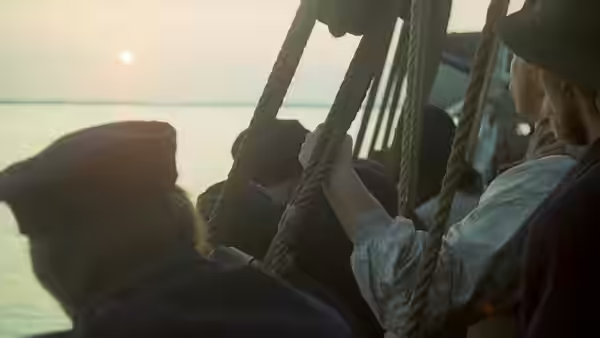
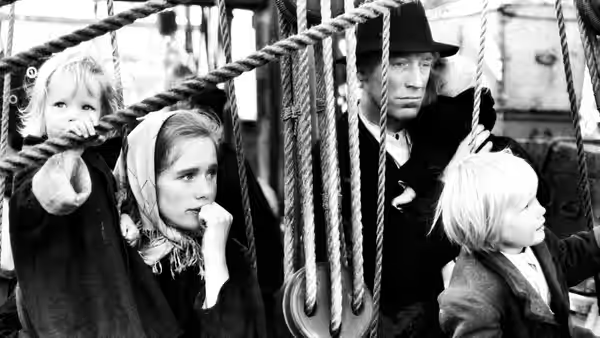
Then the ship. We have seen a good many films cross the Atlantic and none that made us feel it in the stomach as this one did. Troell takes the camera down into the hold and stays there for what feels like weeks: bunks stacked in the dark, buckets, lice picked from seams, a storm heard through planks, passengers who sicken one by one. There is a stretch in which almost nothing happens except that people lie still and wait, and we realised we were waiting with them, wanting land as badly as they did. It is the best sustained sequence in the film and it is done with a hand-held camera and a few lamps.

The film’s faults are the faults of its method. The first hour is repetitive; there are two bad harvests where one would do. Sven-Olof Bern and Aina Alfredsson, as Karl Oskar’s parents, are given little to do but disapprove. Hans Alfredson’s Jonas Petter tells stories that stop the film rather than deepen it. And the religious strand, Danjel against the dean (Gustaf Färingborg), is filmed with a solemnity the rest of the picture is careful to avoid. Some critics have found the whole thing stolid, and we understand why. Troell’s people are not quick, and he refuses to make them quicker for our benefit.

The last stretch, on American soil, we will not describe, except to say that it ends where a lesser film would have put its intermission. That is the point. This is a film about how long the journey takes, and it makes you take it. Watch it in the afternoon, in one sitting, with the second film ready for the next night. The silences carry as much as the lines.
Critical consensus AI synthesised

81
Positive
6
Mixed
1
Negative
0

Most critics are warm, and the praise gathers around two things: the lead performances and the camera. Max von Sydow and Liv Ullmann are singled out again and again, their partnership read as the film’s spine. Jan Troell’s handheld photography, particularly on the Atlantic crossing, is widely admired, as are the long takes and the attention paid to soil, weather and hardship. Several reviewers treat the film and its sequel as one work and say it plays better that way.

The reservations are about pace and feeling. The New York Times finds it stately and episodic, with characters too simply drawn to land emotionally, and Time Out concedes it is slow going before it gets there. The New Yorker admits an early distance from the stolid characters that lifts as the film goes on. The spread runs from lukewarm to unreserved, but nobody dismisses it.

RogerEbert.com
15 January 1973 · ★★★★/4 · Roger Ebert
100

The critic praises the film as a masterpiece that honestly depicts European peasants' desperate emigration to America in search of better lives, highlighting its emotional depth, historical authenticity, and strong performances by Max von Sydow and Liv Ullmann.

Read the full review →
Slant Magazine
9 February 2016 · Carson Lund
85*

The critic finds the films a touching study of the symbiosis between Max von Sydow and Liv Ullmann and Troell's defining accomplishment. He singles out the intimate, handheld camerawork capturing the hellish Atlantic crossing and the gradual erosion of religious certainty among the emigrants.

Read the full review →
The AV Club
6 February 2016 · Mike D'Angelo
80*

The critic views the two films as best experienced together as one satisfying epic and finds the sequel stronger. He singles out the powerful, largely dialogue-free sequence in the second film showing Robert's failed gold-rush journey, cut against his illness in Sweden.

Read the full review →
The New Yorker
23 September 1972 · Pauline Kael
75*

The critic describes the film as a broad-backed nature epic that directly confronts the grim realities of mid-19th-century Swedish emigration and the brutal voyage, praising its earth spirit and resonance despite initial alienation from the stolid characters.

Read the full review →
Time Out
10 September 2012 · GA
70*

The first half of a two-film adaptation of Vilhelm Moberg's novels, it offers an austere, long, and picturesque recreation of Swedish farmers' hardships in the 1850s as they seek a better life in America. It is very slow but subtly acted and ultimately moving, with Troell's multifaceted role underscoring themes of human courage and dignity.

Read the full review →
The New York Times
25 September 1972 · Vincent Canby
60*

The critic finds the film a stately, pictorially romantic chronicle of Swedish peasants' emigration driven by hardship, impressive in conception and location shooting but with reservations about its episodic form, lack of emotional impact, and overly simple characters.

Read the full review →

Cast

Awards

Academy Awards, 1973

Nominated
Best Actress
Nominated
Best Director
Nominated
Best Picture
Nominated
Best Writing, Adapted Screenplay

Academy Awards, 1972

Nominated
Best International Feature Film

International Submission to the Academy Awards, 1972

Nominated
International Submission to the Academy Awards

Silver nugget for the best foreign film, 1971

Won
Silver nugget for the best foreign film

If you liked this, try…

The New Land poster

The New Land

1972 · The second half: the same people, a Minnesota lake, and a harder winter than Sweden’s.

America America poster84

America America

1963 · Kazan’s own family story of getting out; louder than Troell, and just as stubborn.

Pelle the Conqueror poster

Pelle the Conqueror

1987 · Swedes arriving in Denmark rather than leaving; von Sydow again, older and worn down.

Days of Heaven poster85

Days of Heaven

1978 · Malick’s prairie, shot at the same hour of light Troell keeps chasing.

The Immigrant poster

The Immigrant

2013 · Marion Cotillard off the boat at Ellis Island; what waits when the crossing ends.