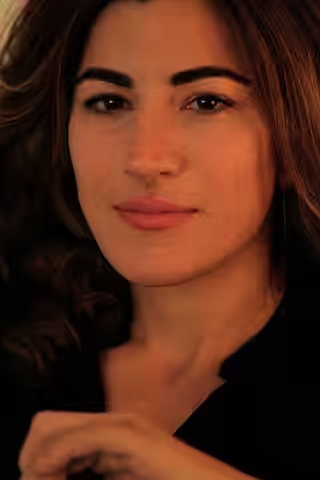
Jehane Noujaim makes large, complicated events legible by following a few people closely. We value her patience and access, but The Great Hack makes stronger claims than its evidence supports.
Fi1m perspective
Noujaim stays close to a few people while larger events unfold around them. Her handheld, ground-level filming puts us among them, and following them over time lets us watch their responses change. We value the patience involved in getting to know someone beyond an interview. The difficulty is knowing how much of the wider story those encounters can explain.
Startup.com (2001), made in collaboration with D.A. Pennebaker and Chris Hegedus, established that observational approach by following a dot-com company. Control Room (2004) examined competing accounts of the same events. By The Square (2013), a small group of participants provides the route through a much larger story. Noujaim's access matters here: sustained proximity lets her build a film around people changing over time, though keeping so close to them can leave the wider circumstances underexplained.
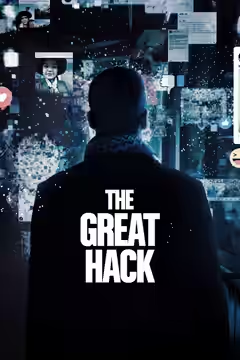
With Karim Amer, she takes that interest in information into The Great Hack (2019), which examines the harvesting of personal data. The film is useful because it makes the collection of that information seem consequential rather than merely technical. We were unsettled by its account of lost privacy, which made the apparently harmless scraps we leave behind feel worth protecting. The documentary does not rely heavily on narration or talking heads to guide us, an approach that keeps a complicated subject within reach.
The difficulty comes when The Great Hack moves from showing that information is collected to claiming what it can make people do. Its confidence about the power of that information exceeds the evidence it supplies, and we are left without a proper measure of how much influence was achieved. That is a substantial weakness in a film asking us to reconsider something so ordinary. We recommend it as an introduction to data harvesting, with that limit kept firmly in mind.
Biography
Jehane Noujaim is an American documentary film director. Born on 17 May 1974 in Washington, D.C., she was raised in Kuwait and Cairo before moving to Boston. She graduated magna cum laude from Harvard University in 1996 with degrees in visual arts and philosophy.
Noujaim's early films include Startup.com (2001) and Control Room (2004). She co-directed The Square (2013) with her spouse Karim Amer; the film received an Academy Award nomination for Best Documentary Feature. She later co-directed The Great Hack (2019) with Amer, examining the Cambridge Analytica scandal. Other credits include directing episodes of the series Ramy (2019) and The Vow (2020–2022).
Noujaim won a TED Prize in 2006 and has received Directors Guild of America Awards for her documentary work.