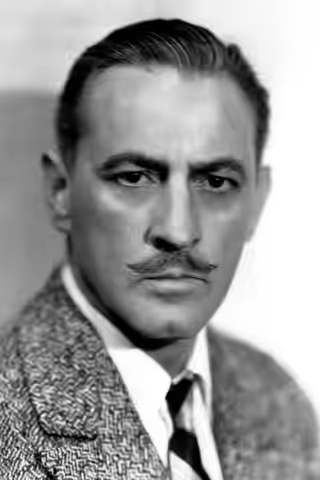
John Barrymore brought a stage voice and a stage face to the screen, and the films caught him twice: in silence, when the face did the work, and in sound, when the voice did and could not always be persuaded to stop.
Fi1m perspective
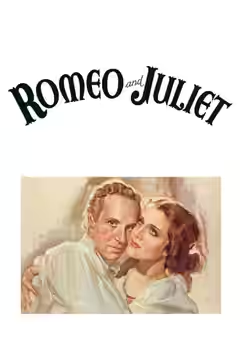
Early in George Cukor's Romeo and Juliet (1936), John Barrymore stands up to describe Queen Mab. He plays Mercutio as a man who has never left a party of his own accord, ripe and showy and a little dangerous, and the speech comes out as a drunk's turn that keeps getting away from him. We laughed, and we were meant to; in a film that treats a play about two impatient children as a state occasion, he and Edna May Oliver are most of the reasons to stay. We also noticed that the laugh had something rueful in it. This is a great talker near the end, doing the thing he was famous for at full volume, and the volume is the point and also the problem.
The volume came from the theatre. Barrymore began on stage in 1903, after a spell studying painting, and was a light comedian before he was anything else; the serious reputation arrived with Justice in 1916, Richard III in 1920 and a Hamlet he played in New York in 1922 and London in 1925. He had been in films since 1913 or 1914, and the silent camera suited him in a way that is easy to forget once you have heard him. In Dr Jekyll and Mr Hyde (1920) the change from one man to the other is done largely with his face, in close-up, and Svengali (1931) went after the same taste for the grotesque. What people remember of that period is control: a face that did exactly what he wanted.
Sound gave him back his voice and took some of the control away. The early thirties were the good years: the Baron in Grand Hotel (1932), a thinly written part he filled out on charm, opposite Greta Garbo; Larry Renault in Dinner at Eight (1933); and Jaffe in Howard Hawks's Twentieth Century (1934), where the theatrical manner is the joke and the film is built to let it run. Cukor directed him three times, and our guess is that he understood the trick: give Barrymore a character who is himself performing, so that the excess reads as the man's rather than the actor's. The Mercutio is that idea one last time.
The complaint against him was always the same, and it goes back to the stage Hamlet: a sudden emphatic stress, a shout or a whisper that arrives from nowhere, effect for its own sake. By the late thirties the roles were often parodies of him, and he played them as such, until his death in 1942. The Mercutio holds both halves of the case in a few scenes: the timing is real, the danger is real, and so is the sense of a performance that would have gone on longer if nobody had cut. Start there, then find Twentieth Century, where the overplaying is the whole idea and nobody is pretending otherwise.
Biography
John Barrymore (born John Sidney Blyth, 15 February 1882 – 29 May 1942) was an American actor. A member of a theatrical dynasty, he was the brother of actors Lionel Barrymore and Ethel Barrymore, and the paternal grandfather of Drew Barrymore.
He began his career on the stage in 1903, first gaining recognition in light comedy before moving into high drama and Shakespearean roles such as Hamlet and Richard III. Barrymore appeared in motion pictures from 1913 onwards, in both silent and sound eras.
Among his film roles are those in Dr. Jekyll and Mr. Hyde (1920), Grand Hotel (1932), Dinner at Eight (1933), Twentieth Century (1934), and as Mercutio in Romeo and Juliet (1936).