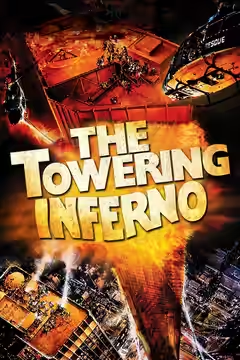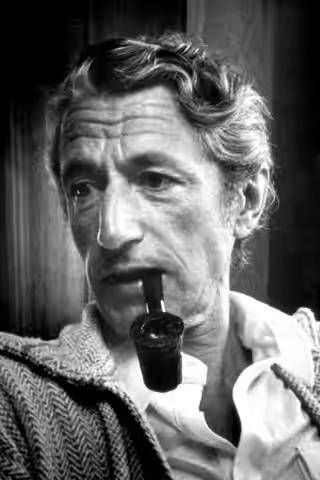
Guillermin built set pieces. He knew how a fire moves through a building and where to put a camera while it burned, and he shot it with a care his people rarely got. The spectacle lasts; the films around it are hit and miss.
Fi1m perspective
The fire in The Towering Inferno (1974) begins in a storeroom, and John Guillermin follows it the way another director would follow a detective. He wants to know which way it goes, what it eats, how long the people above it have. Paul Newman's architect and William Holden's builder argue about wiring; the fire does not argue about anything. That is how he worked. He built the set piece first and fitted the people into it.
He came to spectacle slowly. After the RAF he made documentaries in France, then low-budget British features from the late 1940s, and by the end of the fifties he had a hit with Tarzan's Greatest Adventure (1959), which he also wrote. The Blue Max (1966) made his name, a First World War drama whose flying sequences are still what people remember about it, with George Peppard, who worked with him three times. The Bridge at Remagen (1969) followed, shot largely in Czechoslovakia. Then Hollywood handed him the big machines: Skyjacked (1972), the Glass Tower, and King Kong (1976) for Dino De Laurentiis, the film that gave Jessica Lange her first part. Death on the Nile (1978) took an ensemble to Egypt. After Sheena (1984) the scale shrank, and he stopped working at the end of the eighties.
What he could do was stage. He liked odd angles and a handheld camera in the middle of the action, and he was a perfectionist about it, which is the polite word; producers and crews who worked with him did not always enjoy the experience. The precision shows. Our reservation about The Towering Inferno is the one that applies to most of his big films: the people trapped in them are a good deal less interesting than what is trapping them, and at 165 minutes there is a lot of time to notice. He could hold a shot of a burning stairwell longer than he could hold a conversation.
We will own that the first ninety minutes of that film frightened us, and not because of the stunts. It was the patience: a fire shown as a thing with habits, spreading while the party carried on, so that we knew before the characters did. That patience is Guillermin's, whatever the shared credit says. Asked about that credit late in life, he said, "I wanted to fight it because dammit I made that picture." On the evidence of the fire, he did.
His later films are harder to defend: the machines got bigger and the pictures did not get better. Start with the Glass Tower, and when the cast begin making speeches, remember whose fire it is.
Biography
John Guillermin was a British film director. Born in London on 11 November 1925, he died on 27 September 2015 in Topanga, California.
He began his career in the late 1940s with low-budget British features after studying at Cambridge University, serving in the Royal Air Force and working on documentaries in France. His later credits include The Blue Max (1966), The Bridge at Remagen (1969), The Towering Inferno (1974), King Kong (1976), Death on the Nile (1978), Sheena (1984) and King Kong Lives (1986). He also directed episodes of the 1950s sitcom The Adventures of Aggie.