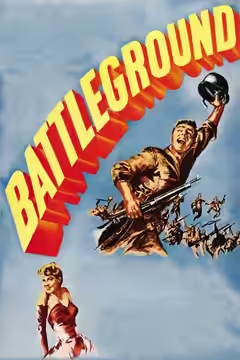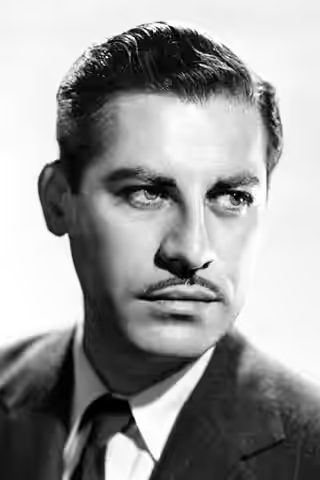
A heavy, watchful face and a deep voice in a studio system that wanted neither, John Hodiak was at his best as one soldier among many and at his weakest as the man the poster was sold on. Start with Battleground.
Fi1m perspective
Look at where John Hodiak stands in a frame and he is usually a step back from the light. He had the build and the voice of a leading man and a face the studios did not know what to do with: rugged, dark, not the smooth article MGM was in the business of selling. He had come to acting from radio in Chicago, after factory work and teaching himself to lose an accent, and he never took a dramatic lesson. What he brought instead of technique was stillness, and stillness reads as strength when the script is good and as glumness when it is not.
MGM signed him around 1942 for small parts, and the break came on loan to Fox, as Kovac in Hitchcock's Lifeboat (1944), where he held his own in a very small boat against Tallulah Bankhead. Fox gave him the title role in A Bell for Adano (1945) and MGM put him opposite Judy Garland in The Harvey Girls (1946), and for two or three years he was a star. Then he was not. By the end of the decade he had slipped into supporting parts, and the harsher critics of The Miniver Story and A Lady Without Passport, both 1950, were calling him wooden.
The film that uses him properly is Battleground (1949), the second of his two with William A. Wellman. He is second billed, as Private Jarvess, and asked to be nothing more than one cold, grumbling man in a squad in one foxhole. Our review of the film does not single him out, and that is to his credit rather than against it: Wellman wanted men, not stars, and Hodiak gave him one. We came away from it fonder of him than we have ever been when he was carrying a picture, because he is at his best when nobody is watching him in particular and he knows it.
The stage gave him what the studios would not. He originated Lieutenant Maryk in The Caine Mutiny Court-Martial on Broadway in 1954, a tough, doubting military man of exactly the kind Hollywood had kept handing him and then not filming with much interest, and it earned him the warmest reception of his career. He died in 1955, at 41, while finishing On the Threshold of Space. "No part has ever come easily to me," he said. "Every one has been a challenge." It shows, and not always to his disadvantage.
If you want to see what he could do, do not look for the film where he is the whole point. Watch Battleground and find the man who is not asking to be looked at.
Biography
John Hodiak (16 April 1914 – 19 October 1955) was an American actor who worked in radio, stage and film. Born in Pittsburgh, Pennsylvania, he began his career in radio in Detroit and Chicago before moving to Hollywood, where he signed with MGM in 1942.
He gained attention with roles in Lifeboat (1944) and A Bell for Adano (1945). Among his best-known films are The Harvey Girls (1946), Somewhere in the Night (1946) and Battleground (1949), in which he played Jarvess. He also appeared on stage, notably in The Caine Mutiny Court-Martial.
Hodiak was married to actress Anne Baxter from 1946 to 1953; they had one daughter. He died of a heart attack in Los Angeles at the age of 41.